

Why Do Biotech Labs Need an Ultrasonic Cell Disruptor? Protein, Enzyme and DNA/RNA Extraction
How ultrasonic cell disruption releases intracellular materials
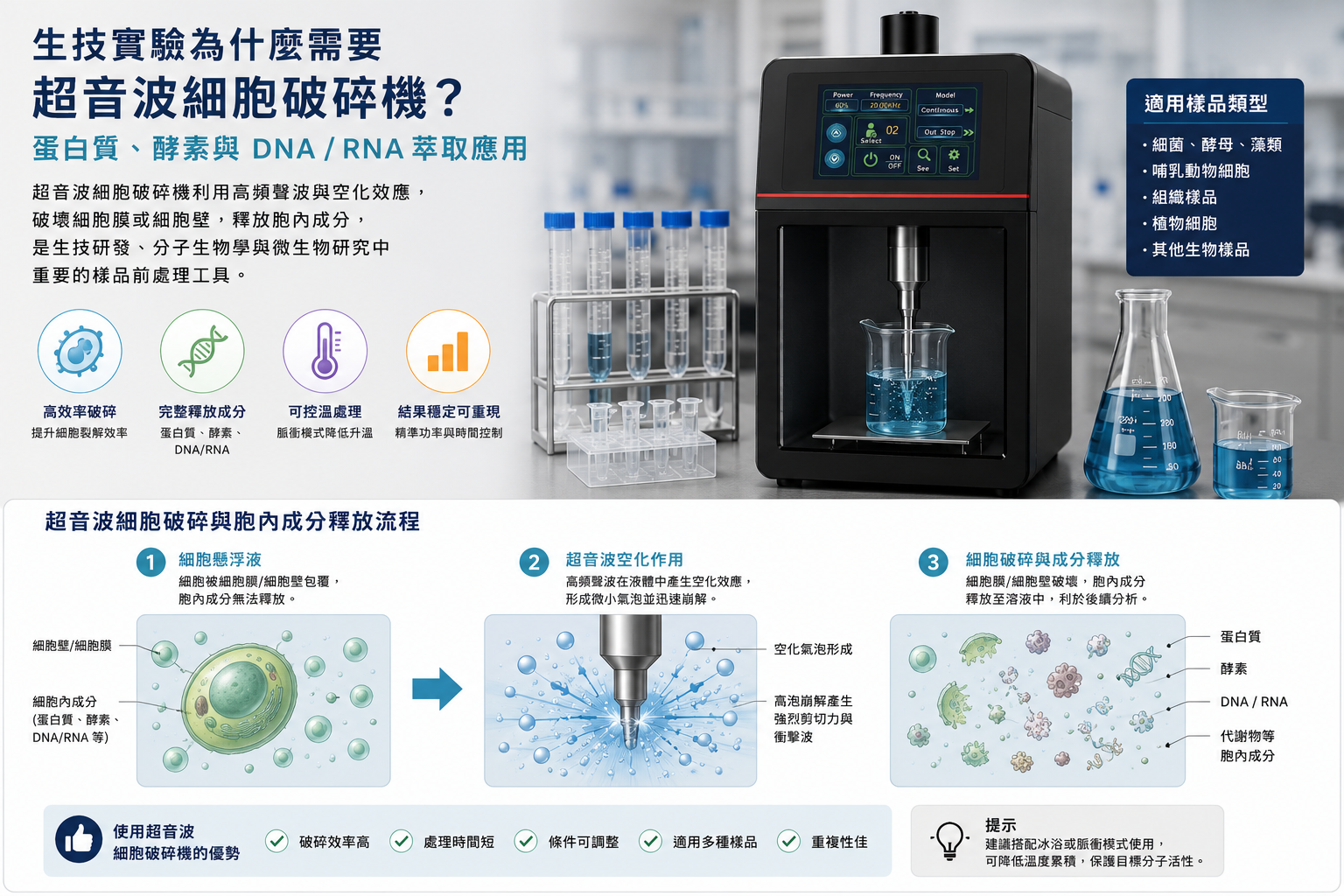
Many biotechnology analyses begin with access to intracellular materials. Protein studies require target proteins; enzyme studies need active enzymes; molecular biology may require DNA or RNA; and microbiology often involves opening bacterial or yeast cells. If the cell membrane or wall is not disrupted sufficiently, release, extraction and purification may be affected. An ultrasonic cell disruptor uses acoustic energy to support cell lysis and release intracellular contents into a liquid.
How cavitation works
A probe delivers high-frequency sound waves into a liquid sample. Rapid compression and expansion create microscopic bubbles. When these bubbles collapse, they generate localized shear forces, shock waves and microstreaming that can disrupt cell membranes or walls. The process can be viewed in three steps: the probe introduces acoustic energy, cavitation bubbles form and collapse, and the resulting forces break cell structures to release proteins, enzymes and nucleic acids.
Protein and enzyme extraction
Ultrasonic disruption can release proteins from bacteria, yeast or mammalian cells for purification, quantification, electrophoresis, activity testing or functional analysis. The goal is controlled energy input, not simply maximum disruption. Excessive treatment can heat the sample and affect temperature-sensitive proteins or enzymes. Pulse mode, an ice bath and short treatment intervals can help limit heat buildup. Record power, time and temperature to improve repeatability.
DNA/RNA preparation and microbial samples
Ultrasonic treatment can assist cell lysis or nucleic-acid release in some sample-preparation workflows. DNA and RNA are sensitive to shearing and degradation, so avoid excessive treatment when intact nucleic acids are required. Bacteria, yeast and mammalian cells differ in disruption difficulty. Start with mild conditions and adjust power, duration, pulse ratio and cooling gradually.
Equipment selection and operating points
Fulcrum Technology’s co-developed ultrasonic homogenizer/cell disruptor includes FTZ split-type and FT benchtop series, with probe options and power control for emulsification, dispersion, cell disruption and nano-processing. Before selecting equipment, define sample type, batch volume, target material, heat sensitivity and desired throughput. Match the probe to sample volume, monitor temperature, optimize treatment time and use pulsing or cooling as needed. Record power, sample concentration, volume and cooling conditions for repeatability and scale-up.
FAQ
The equipment may be evaluated for bacteria, yeast, mammalian cells and some tissue samples; conditions depend on the sample and target. Excess heat or over-processing may affect protein or enzyme activity, so use cooling and pulse mode where appropriate. There is no universal power setting; optimize based on sample type, volume, concentration and desired result. The system can support some DNA/RNA preparation, but treatment must be adjusted to limit unwanted shearing. For selection advice, provide your sample conditions, batch size and goal so Fulcrum Technology can assess FTZ or FT options.
Need help with cell disruption or biotech sample preparation? Contact Fulcrum Technology for product specifications, application guidance and quotation information.