


Aurora Spectrophotometer | 9 Apertures, UV Source & Advanced Color Control
Aurora Spectrophotometer | 9 Apertures, UV Source & Advanced Color QC
Aurora Spectrophotometer is 3nh’s high-end array spectrophotometer with D/8 geometry, a dual 40-element silicon photodiode sensor, balanced full-spectrum LED and UV light sources. It supports SCI/SCE measurement modes, UV-included or UV-excluded measurement, spectral reflectance and Lab color data and ΔE evaluation.
Aurora comes with nine apertures: flat and pointed 3, 5, 10 and 11 mm apertures, plus a narrow 1 × 3 mm aperture. They support evaluation of samples of different sizes, curved surfaces, localized areas and special measurement points. Applications include plastics, coatings, inks, textiles, printing, ceramics, electronic materials, packaging and R&D. Confirm the setup for the material, surface, measurement area, gloss, fluorescence and QC procedure.
Aurora Highlights
Nine Measurement Apertures
Flat and pointed 3, 5, 10 and 11 mm apertures, plus a narrow 1 × 3 mm aperture. Choose an aperture for the sample size, measurement area, curved surface, localized area or narrow point.
UV Measurement Conditions
Evaluate fluorescent materials, optical brighteners and UV-sensitive samples. Select UV-included or UV-excluded measurement according to the sample and inspection standard.
D/8 and SCI/SCE
D/8 geometry and SCI/SCE support color comparison with or without the specular reflection component.
CCD Camera Positioning
View the measurement area for localized color patches, small areas, printed patterns and specified points. Confirm the aperture and positioning method for the sample.
Applications
Different Sample Sizes and Special Measurement Points
Nine apertures support samples of different sizes, localized areas, narrow regions, curved surfaces and hard-to-contact points. Select according to sample shape and target area.
Fluorescent Materials and UV Conditions
The UV source helps evaluate fluorescent or UV-sensitive materials, including samples with optical brighteners, special coatings, textiles and paper.
Supply-Chain Acceptance and Standard Color Management
Use Aurora to set standard colors, compare batches, accept incoming materials and manage color data across sites. Align the ΔE formula, illuminant and SCI/SCE condition with customer acceptance criteria.
R&D Formulation and Process QC
For QC workflows using spectral, Lab and ΔE data with plastics, coatings, inks, textiles, printing, ceramics, electronic materials and packaging.
Aurora Feature Details
Multi-Platform Color Data Management
Depending on the supplied version, Android, iOS, Windows, WeChat Mini Program or HarmonyOS may be available for color data management, difference comparison and report export, supporting QC records, supplier-batch comparison and internal color standards.
Dual 40-Element Silicon Photodiode Sensor
The dual 40-element array sensor supports spectral data acquisition, color evaluation and batch comparison for applications requiring stable data and advanced color management. Results depend on the sample, calibration and QC procedure.
Multiple Color Spaces and Observer Illuminants
Available evaluations may include CIE LAB, XYZ, Yxy, LCh, CIE LUV, s-RGB and HunterLab, with D65, A, C, D50, D55, D75, F-series and LED illuminants. Confirm availability for the instrument settings and software version.
Ergonomic Design and Operation
The large touchscreen displays results and color-assessment information. The grip and measurement button support field inspection, laboratory comparison and everyday QC.
Nine-Aperture Configuration
Flat and pointed 3, 5, 10 and 11 mm apertures plus a narrow 1 × 3 mm aperture support large areas, small or curved surfaces, narrow regions and localized points. Select the aperture for the actual sample.
Camera-Assisted Positioning
The integrated camera provides a live view of the target area so you can check whether the measurement point is centered. For color patches, printed patterns or small points, confirm both the aperture and positioning method.
Dual Optical System
The dual optical design supports evaluation of measurement stability and environmental effects for long-term QC, batch comparison and cross-department color-data management. Results depend on calibration, sample and measurement conditions.
Repeatability and Inter-Instrument Difference
Manufacturer materials describe repeatability and inter-instrument control. Evaluate multi-instrument comparison, cross-site color management and long-term QC against calibration, sample and measurement procedures.
Grating Spectral Technology
The grating supports spectral data acquisition, color evaluation and batch ΔE comparison for workflows requiring spectral reflectance, Lab data and color-difference management.
Non-Contact Automatic White-Tile Calibration
Depending on the supplied version, a smart calibration base may support non-contact white-tile calibration and daily measurement readiness. Follow manufacturer guidance and QC procedures for tile care, cleaning and calibration frequency.
Balanced Full-Spectrum LED and UV Sources
Aurora combines full-spectrum LED and UV sources to evaluate ordinary reflected color, fluorescent materials, optical brighteners and special coatings. Choose UV-included or UV-excluded measurement for the objective and inspection standard.
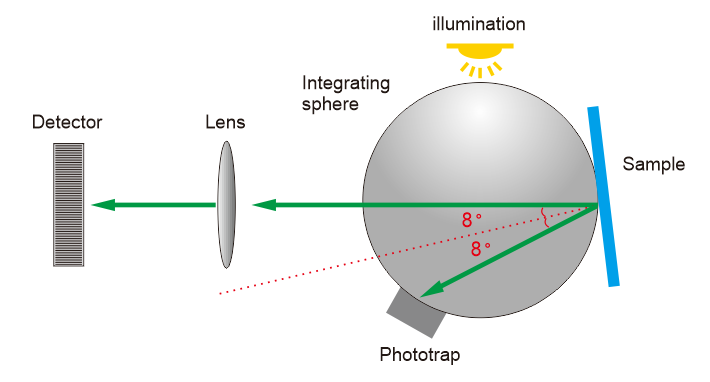
D/8 SCI/SCE Measurement Structure
D/8 SCI/SCE supports color comparison with or without specular reflection and can be applied to glossy, matte, coated or textured samples. Confirm the applicable condition in the inspection standard.
How Aurora Compares with Other High-End Spectrophotometers
Consider Aurora when you need nine apertures, a UV source, camera positioning and D/8 SCI/SCE. For other configurations, compare FTS7000 and FTZ9, or explore the high-end handheld spectrophotometer range. Contact us if you need help comparing models.
Aurora FAQs
Q1: Which samples and industries are suitable for Aurora?
Aurora can be evaluated for plastics, coatings, inks, textiles, printing, ceramics, electronic materials, packaging and R&D. For samples that vary in size, curvature, local area, fluorescence or gloss, provide the sample conditions to confirm the aperture and measurement method.
Q2: How should I choose among Aurora’s nine apertures?
Flat apertures suit samples with sufficient, relatively even area; pointed apertures can be evaluated for uneven, curved or hard-to-contact surfaces; the 1 × 3 mm aperture is for narrow or special points. Choose by sample dimensions, point shape and repeatability needs.
Q3: Is the UV source suitable for fluorescent samples?
Aurora has a UV source for fluorescent or UV-sensitive samples. For optical brighteners, special coatings, textiles or paper whiteness, confirm UV-included or UV-excluded conditions against the applicable standard.
Q4: What is the purpose of SCI/SCE measurement?
SCI includes the specular reflection component; SCE excludes it for an appearance assessment closer to visual observation. Align whether to use SCI, SCE or both for glossy, matte or coated samples and customer acceptance criteria.
Q5: What data-management workflows does Aurora support?
Depending on the supplied version, multi-platform software may organize color data, compare differences and export reports for supplier-batch comparison, standard color management, R&D records and QC traceability.
Q6: What information should I provide before selecting Aurora?
Provide the material, sample and measurement-point dimensions, surface condition, gloss or texture, fluorescence, ΔE formula and tolerance, SCI/SCE or UV needs, and record/report requirements to confirm the aperture and measurement procedure.
Is Aurora Right for Your Multi-Aperture QC Workflow?
Share your material, measurement area, surface, fluorescence, SCI/SCE needs, color-difference formula and acceptance standard to confirm whether Aurora or another 3nh spectrophotometer fits your process.
Contact Fulcrum Technology for consultation and a quotationAurora Array Spectrophotometer Specifications
| Specification | Details |
|---|---|
| Product model | Aurora array spectrophotometer |
| Measurement geometry | D/8 (diffuse illumination, 8° viewing); SCI/SCE; UV included/excluded. Complies with CIE No.15, GB/T3978, GB2893, GB/T18833, ISO 7724-1, ASTM E1164 and DIN 5033 Teil 7. |
| Detector | Large-area dual silicon photodiode array, 40 elements |
| Spectral method | Planar diffraction grating |
| Integrating sphere diameter | Φ40 mm |
| Illumination | Combined full-spectrum LED and UV |
| Wavelength range | 400–700 nm |
| Observer illuminants | D65, A, C, D50, D55, D75, F1, F2 (CWF), F3, F4, F5, F6, F7 (DLF), F8, F9, F10 (TPL5), F11 (TL84), F12 (TL83/U30), B, U35, NBF, ID50, ID65, LED-B1, LED-B2, LED-B3, LED-B4, LED-B5, LED-BH1, LED-RGB1, LED-V1, LED-V2, LED-C2, LED-C3, LED-C5; custom illuminants (41 total; some through software/app). |
| Wavelength interval | 10 nm |
| Reflectance range | 0–200% |
| Measurement apertures | 9 apertures: flat and pointed 3, 5, 10 and 11 mm; plus 1 × 3 mm |
| Black/white calibration | Black/white calibration box |
| Specular component | Simultaneous SCI/SCE |
| Color spaces | CIE LAB, XYZ, Yxy, LCh, CIE LUV, s-RGB, HunterLab, βxy, DIN Lab99, Munsell (C/2) |
| Color difference formulas | ΔE*ab, ΔE*uv, ΔE*94, ΔE*cmc (2:1), ΔE*cmc (1:1), ΔE*00, DIN ΔE99, ΔE (Hunter) |
| Other indices | Spectral reflectance; whiteness (ASTM E313-00/-73, CIE/ISO, AATCC, Hunter, Taube, Berger, Stensby); yellowness (ASTM D1925, E313-00/-73); metamerism index Mt; staining fastness; color change fastness; strength (dye strength/coloring power); opacity; 8° gloss; 555 hue classification; blackness My, dM; CMYK density (A, T, E, M); Tint (ASTM E313-00); color density; Munsell (some via software/app). |
| Observer angle | 2° / 10° |
| Display parameters | Spectrum plot/data, sample color values, color difference/value/chart, pass/fail, color simulation and color cast |
| Measurement time | Approx. 1.5 sec |
| Repeatability | Color value MAV/SCI ΔE*ab ≤ 0.015 (after warm-up and calibration; average of 30 white-tile readings at 5-second intervals); spectral reflectance MAV/SCI SD ≤ 0.07% |
| Inter-instrument difference | MAV/SCI ΔE*ab ≤ 0.15 (BCRA Series II; average across 12 color tiles) |
| Display resolution | 0.01 |
| Measurement modes | Single; average of 2–99 readings |
| Positioning | CCD viewfinder and alignment plate |
| Dimensions | 114 × 70 × 208 mm (H × W × D) |
| Weight | 435 g |
| Battery | Li 3.7 V, 5000 mAh; up to 8,500 readings within 8 hours |
| Lamp life | Approx. 10 years; >1.5 million measurements |
| Display | 3.5-inch full-color TFT capacitive touchscreen |
| Connectivity | USB, Bluetooth 5.0 |
| Data storage | 500 standards, 20,000 samples (one data line can include SCI/SCE together) |
| Software | Windows, Android, iOS |
| Languages | Traditional Chinese, Simplified Chinese, English |
| Operating conditions | 0–40°C; 0–85% RH, non-condensing; altitude <2,000 m |
| Storage conditions | −20–50°C; 0–85% RH, non-condensing |
| Standard accessories | Power supply, data cable, manual, QC software (download from website), black/white calibration box, protective cover, wrist strap and apertures |
| Optional accessories | Micro printer, powder test box |
Selection note: Aurora is a high-end nine-aperture colorimeter for samples of different sizes and shapes, fluorescent materials and special measurement points. Share the sample information to confirm aperture, SCI/SCE conditions and data-management needs. Specifications are based on current product information; confirm the actual version with the manufacturer or Fulcrum Technology.
Related Products
The TS-26D horizontal spectrophotometer uses D/8 geometry with SCI/SCE measurement and a combined full-spectrum LED and UV light source. Choose among three apertures—MAV Φ8/Φ10 mm, SAV Φ4/Φ5 mm, or SSAV 1 × 3 mm—to suit the sample and measurement area. It supports spectral reflectance, L*a*b* values and ΔE color assessment for plastics, electronics, coatings, inks, textiles, printing, ceramics, packaging, R&D and quality control. Confirm aperture, UV settings and SCI/SCE conditions against your sample and inspection standards.
For configuration or measurement-method guidance, contact Fulcrum Technology.