

3nh PS08 Skin Colorimeter
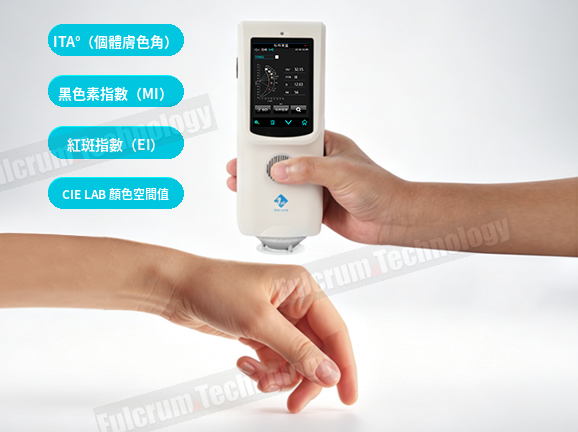
3nh PS08 Skin Colorimeter applies spectrophotometric color measurement to skin, skincare, beauty and cosmetics research. In one measurement workflow it can provide ITA° (Individual Typology Angle), melanin index (MI), erythema index (EI) and CIE L*a*b* color data. These recorded values help teams document and compare observations over time instead of relying on visual impressions alone.
It is suited to skincare before-and-after comparisons, beauty-service observations, skin-color tracking, cosmetics R&D, skin-simulant testing and related research. For longitudinal comparisons, keep the measurement location, environment and procedure as consistent as possible.
Four types of skin-color data in one workflow
The PS08 can collect several complementary skin-color measures during a measurement workflow. Use the metrics together with a defined protocol; interpretation depends on the measured area, conditions and application.
Reduce visual-assessment variation with spectrophotometric measurement
Skin appearance in photographs or visual inspection can vary with illumination, camera settings, viewing angle and observer judgment. The PS08 uses D/8 optical geometry and spectrophotometric measurement to support a more consistent way to record skin-color data.
SCI/SCE measurement modes are supported. When comparing dates or stages, keep the measurement location, mode, environment and operating procedure consistent, then review changes in ITA°, MI, EI and CIE L*a*b* data.
Skin condition, location, environment and technique can all affect readings. A documented, repeatable measurement process makes comparisons easier to interpret.
Track skin-color changes by location and time point
Record measurements from defined areas such as the face, neck, chest or arm, and organize readings by date according to the test plan.
- Separate locations: keep records for each target area distinct.
- Compare time points: review MI, EI, ITA° and Lab values under the same procedure.
- Follow product-use stages: document readings before and after skincare or beauty procedures.
- Build a longitudinal record: arrange results by date to observe trends.
For longitudinal tracking, keep location, environment and operating method as consistent as possible.

Support before-and-after comparisons in skincare and cosmetics
Photos and subjective impressions can be affected by surroundings and capture conditions. PS08 measurements provide recorded color values that can support comparisons for product testing, cosmetics R&D and beauty applications.
- Record skin-color values at consistent conditions for sun-care related tests.
- Track ITA°, MI or color-coordinate changes during brightening-product research without treating readings as proof of efficacy.
- Pair visual observations with erythema-related and color measurements in beauty workflows.
- Compare formulations, products or test stages using a documented protocol.
The PS08 provides skin-color measurement data. It is not intended for medical diagnosis, disease assessment or determination of treatment efficacy.
Use CIE L*a*b* data to review lightness and color direction
In addition to ITA°, MI and EI, the PS08 provides CIE L*a*b* color data for examining lightness and color-direction changes.
Read more about CIE L*a*b* color values and color difference and ΔE. Use an appropriate evaluation method and acceptance criteria for your application.
Typical application settings
Choose the measurement procedure and record-keeping method to suit the objective.
Routine skin tracking
Record readings at defined locations and review changes over time.
Skincare comparisons
Document skin-color data at planned stages before and after product use.
Beauty consultations
Pair visual notes with measurements for consistent follow-up records.
Product testing
Support comparisons across products, formulations or test stages.
Cosmetics R&D
Use skin-color measurements in formulation and product-development workflows.
Skin simulants and research
Compare color data for simulants and related materials when appropriate to the study.
How to choose between PS08, PS01, PS02 and general color instruments
The PS08 focuses on skin-color metrics, including ITA°, MI, EI and CIE L*a*b*, with D/8 geometry and SCI/SCE modes. The PS01 is oriented toward routine, quick skin measurements; the PS02 uses 45/0 geometry for portable before-and-after workflows. For plastics, inks, coatings, printing, textiles, packaging and other manufactured materials, consider a general colorimeter or spectrocolorimeter.
| Instrument | Typical focus | Measurement approach |
|---|---|---|
| PS01 | Routine skin-color checks | Quick, portable measurements |
| PS02 | Detailed portable before-and-after comparisons | 45/0 optical geometry |
| PS08 | Skin-color metrics and research workflows | D/8 integrating sphere; SCI/SCE; ITA°, MI, EI and CIE L*a*b* |
| General colorimeter / spectrocolorimeter | Industrial material color and quality control | Choose according to color-difference or spectral-data requirements |
Learn about SCI and SCE measurement modes before defining a comparison procedure.
Information to prepare for a product consultation
- Target and location: face, arm, neck, skin simulant or another sample.
- Data of interest: ITA°, MI, EI, CIE L*a*b* or before-and-after color changes.
- Test purpose: cosmetics R&D, skincare comparison, beauty observation or research.
- Workflow: measurement frequency, location control, environment and record-keeping needs.
Frequently asked questions
What skin data can the PS08 measure?
It provides ITA°, melanin index (MI), erythema index (EI) and CIE L*a*b* color data.
Can it support skincare before-and-after comparisons?
It can record color values and related metrics at planned stages. Keep the measurement locations, conditions and procedure consistent. The readings are not a determination of medical or cosmetic efficacy.
Can measurements from different skin locations be compared directly?
Different locations may have different characteristics. For a before-and-after comparison, use the same location, environment and operating procedure.
What do ITA°, MI and EI represent?
ITA° is used to describe skin-tone categories; MI records a melanin-related index; EI records an erythema-related index.
Is the PS08 a medical diagnostic device?
No. It measures skin-color data and is not intended to diagnose conditions or determine treatment outcomes.
Need help selecting a skin-color measurement workflow?
Share your target sample, metrics, comparison plan and operating conditions with Fulcrum Technology for product and application guidance.
Technical specifications
| Item | Specification |
|---|---|
| Model | PS08 |
| Optical geometry | D/8 diffuse illumination, 8° viewing |
| Measurement applications | Skin color; ITA°; skin-tone classification; melanin index (MI); erythema index (EI) |
| Integrating sphere | Φ40 mm |
| Light source | Combined full-spectrum LED |
| Spectral device | Plane grating |
| Sensor | Silicon photodiode array, dual rows with 32 groups |
| Wavelength range | 400–700 nm |
| Wavelength interval | 10 nm |
| Spectral bandwidth | 10 nm |
| Colorimetric range | L*: 0–120; reflectance: 0–200% |
| Measurement aperture | Φ8 mm |
| Measurement method | Optical focusing |
| SCI/SCE | Simultaneous measurement |
| Color spaces | CIE L*a*b*, XYZ, Yxy, L*C*h |
| Color difference | ΔE*ab |
| Skin metrics | ITA°, skin type, EI and MI |
| Standard observer | 2° / 10° |
| Illuminant | D65 |
| Display | 3.5-inch TFT capacitive touchscreen; classification chart, sample values, difference, pass/fail, simulation and color cast |
| Resolution | 0.01 |
| Measurement time | Approx. 1.5 s; SCI/SCE approx. 3.2 s |
| Repeatability | MAV/SCI: ΔE*ab ≤ 0.04 after warm-up and calibration; 30 white readings averaged at 5-second intervals |
| Inter-instrument agreement | ≤ 0.35 across 12 BCRA Series II tiles |
| Measurement count | Single or average of 2–99 readings |
| Positioning | Fixture stabilizer |
| Dimensions | 81 × 71 × 214 mm |
| Weight | Approx. 460 g |
| Battery | Approx. 6,000 measurements / 8 hours |
| Light-source life | 5 years or more than 3 million measurements |
| Connectivity | USB / Bluetooth |
| Storage | 1,000 standards and 20,000 samples; expandable through app |
| Languages | Simplified Chinese, English and Traditional Chinese |
| Operating conditions | 0–40 °C; 0–85% RH, non-condensing; altitude below 2,000 m |
| Storage conditions | −20–50 °C; 0–85% RH |
| Standard accessories | Power adapter, cable, manual, SQCX software, black/white calibration box, cap, wrist strap, Φ8 mm tip and MOBCCS app |
| Optional accessories | USB mini printer, powder test box and Bluetooth mini printer |
| Standards | CIE No. 15; GB/T 3978; GB 2893; GB/T 18833; ISO 7724-1; ASTM E1164; DIN 5033 Part 7 |
| Note | Specifications, accessories, versions, interfaces and operating conditions may vary; confirm the latest configuration with the supplier. |