


3nh Spectrophotometer ST70
ST70 Spectrophotometer | Multi-aperture D/8 SCI/SCE and UV Color Quality Control
ST70 Spectrophotometer uses D/8 geometry and supports SCI/SCE measurement and rapid simultaneous SCI+SCE measurement, making it suitable for workflows requiring SCI/SCE color comparison, Lab color data and ΔE evaluation, reflectance analysis, incoming inspection, R&D comparison, and process quality control.
The ST70 offers multiple measurement apertures, a combined full-spectrum LED and UV light source, and color-testing applications across plastics and electronics, paints and inks, textiles and dyeing, printing and paper, ceramics, and laboratory R&D. Confirm model suitability against sample size and surface, measurement area, gloss, fluorescence, aperture requirements, and your quality-control process.
ST70 Spectrophotometer Features
Designed for multi-aperture measurement, D/8 SCI/SCE, UV conditions, camera-assisted targeting, and color-data management.
Dual-row, 32-element sensor array
A large-area photodiode array with two rows of 32 elements supports evaluation of measurement speed, stability, and consistency for ongoing quality control and batch color comparison.
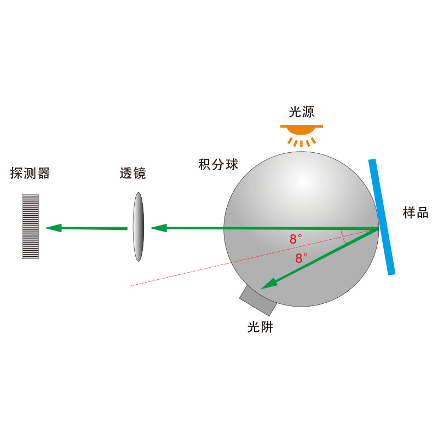
D/8 geometry with SCI/SCE measurement
D/8 illumination and viewing geometry supports SCI/SCE measurement and simultaneous rapid SCI+SCE measurement, enabling comparison with and without specular reflection.
Full-spectrum LED and UV light sources
The combined LED and UV sources support evaluation of fluorescent samples, optical-brightener materials, and color differences under different illuminants.
Multiple measurement apertures
The standard configuration includes Φ8 mm flat and pointed apertures, Φ4 mm flat and pointed apertures, and a 1 × 3 mm pointed aperture. Select an aperture according to sample size, measurement location, and surface conditions.
Camera-assisted measurement targeting
The built-in camera-assisted targeting helps operators confirm that the measurement spot is on the target area, making it useful for small areas, localized color differences, and repeatable measurement points.
Non-contact automatic calibration
The non-contact automatic calibration workflow uses a standard white tile to help maintain consistent day-to-day measurement conditions. Follow the manufacturer’s instructions for calibration.
Protective instrument stand
The stand helps protect the white tile and instrument contact surfaces, reducing contamination risk during storage, handling, and calibration.
Multiple color spaces and illuminants
Supports CIE LAB, XYZ, Yxy, LCh, CIE LUV, s-RGB, HunterLab, βxy, DIN Lab99, and Munsell color spaces, with multiple illuminants for color comparison.
Comprehensive colorimetric indicators
Color-data management can include spectral reflectance, whiteness, yellowness, metamerism index, staining and colorfastness, color strength, opacity, and color density. Some functions depend on software or app support.
Accuracy and repeatability
Evaluate multi-instrument consistency, color-matching workflows, and color communication. Actual measurement performance depends on sample conditions, calibration, and the operating environment.
Android and iOS app support
Depending on the supplied version and software configuration, mobile data-management apps for Android or iOS may support color-data organization, color-difference comparison, and on-site quality records. Confirm supported functions for the specific version.
What to confirm before implementation
For small, curved, textured, glossy, fluorescent, optical-brightener, or multi-supplier samples, provide the sample conditions, test objective, aperture requirements, SCI/SCE settings, and internal acceptance criteria before confirming whether the ST70 fits your quality-control workflow.
Contact Fulcrum Technology for selection adviceST70 Spectrophotometer Specifications
These specifications can support ST70 selection, procurement, and quality-control planning. The ST70 uses D/8 geometry and supports SCI/SCE measurement, UV illumination, multiple apertures, Lab color data, ΔE evaluation, spectral reflectance, and a range of colorimetric indicators. Applications include plastics and electronics, paints and inks, textiles and dyeing, printing and paper, ceramics, R&D laboratories, and process quality control. Confirm model suitability against sample size and surface, measurement area, gloss, fluorescence, aperture requirements, and your quality-control process.
| Product model | 3nh ST70 Spectrophotometer |
|---|---|
| Illumination geometry | D/8 (diffuse illumination, 8° directional reception); SCI/SCE; includes/excludes UV measurement; conforms to CIE No.15, GB/T 3978, GB 2893, GB/T 18833, ISO 7724-1, ASTM E1164, and DIN 5033 Part 7 |
| Integrating sphere diameter | Φ40 mm |
| Illumination source | Combined full-spectrum LED and UV sources |
| Spectral method | Planar grating |
| Detector | Large-area silicon photodiode array (two rows of 32 elements) |
| Wavelength range | 360–780 nm |
| Wavelength interval | 10 nm |
| Reflectance range | 0–200% |
| Measurement apertures | Five apertures: MAV Φ8 mm / Φ10 mm; SAV Φ4 mm / Φ5 mm; LAV 1 × 3 mm |
| Measurement mode | Simultaneous SCI / SCE measurement |
| Color spaces | CIE LAB, XYZ, Yxy, LCh, CIE LUV, s-RGB, HunterLab, βxy, DIN Lab99, Munsell (C/2) |
| Color-difference formulas | ΔE*ab, ΔE*uv, ΔE*94, ΔE*cmc (2:1), ΔE*cmc (1:1), ΔE*00, DIN ΔE99, ΔE (Hunter) |
| Other colorimetric indicators | Spectral reflectance; WI (ASTM E313, CIE/ISO, AATCC, Hunter, Taube-Berger-Stensby); YI (ASTM D1925, ASTM 313); metamerism index Mt; staining and colorfastness; color strength; opacity; 8° gloss; 555 hue classification; blackness (My, dM); CMYK color density (A, T, E, M); tint; color density; Munsell (some functions require PC software) |
| Standard observer | 2° / 10° |
| Illuminants | D65, A, C, D50, D55, D75, F1, F2 (CWF), F3, F4, F5, F6, F7 (DLF), F8, F9, F10 (TPL5), F11 (TL84), F12 (TL83 / U30), B, U35, NBF, ID50, ID65, LED-B1, LED-B2, LED-B3, LED-B4, LED-B5, LED-BH1, LED-RGB1, LED-V1, LED-V2, LED-C2, LED-C3, LED-C5, plus customizable sources (41 in total; some require PC software or an app) |
| Display | Spectral graph / data, sample colorimetric values, color difference / graph, pass / fail result, color simulation, color bias |
| Measurement time | Approx. 1.5 seconds |
| Repeatability | Colorimetric value: MAV / SCI, ΔE*ab within 0.02 (average of 30 white-tile measurements at 5-second intervals after warm-up and calibration); spectral reflectance: MAV / SCI, standard deviation within 0.08% (within 0.18% at 400–700 nm) |
| Inter-instrument difference | MAV / SCI, ΔE*ab within 0.15 (average across 12 BCRA Series II color tiles) |
| Display resolution | 0.01 |
| Measurement method | Single measurement or average measurement (2–99 readings) |
| Positioning | Camera-assisted targeting, stabilizer positioning |
| Dimensions | L × W × H = 129 × 76 × 217 mm |
| Weight | Approx. 600 g |
| Battery | Lithium battery, 3.7 V, 5000 mAh; approx. 8,800 measurements within 8 hours |
| Illumination source service life | 10 years; more than 1.5 million measurements |
| Display screen | 3.5-inch TFT color capacitive touchscreen |
| Interfaces | USB, Bluetooth 5.0 |
| Data storage | 1,000 standards and 30,000 samples (each record can include both SCI / SCE); large-capacity app / PC storage |
| Software support | Android, iOS, Windows, WeChat Mini Program, HarmonyOS |
| Languages | Simplified Chinese, English, Traditional Chinese |
| Operating temperature | 0–40°C; 0–85% RH (non-condensing); altitude below 2,000 m |
| Storage temperature | -20–50°C; 0–85% RH (non-condensing) |
| Standard accessories | Power adapter, data cable, user manual, quality-control software (download from the official website), black/white calibration box, protective cap, wrist strap, Φ8 mm flat and pointed apertures, Φ4 mm flat and pointed apertures, 1 × 3 mm pointed aperture |
| Optional accessories | Mini printer, powder test box |
Specification note: The ST70 is a multi-aperture D/8 SCI/SCE spectrophotometer with a UV source, suitable for quality-control workflows involving different sample sizes, localized measurements, fluorescence conditions, or broader color-data management. Earlier product copy inconsistently referred to four versus five apertures; this table lists five according to the technical parameters. Confirm supplied accessories, software support, and configuration with Fulcrum Technology.