


Spectrocolorreader CR9 (Advanced)
CR9 Advanced Handheld Spectrophotometer
CR9 handheld spectrophotometer with dual 4/8 mm apertures and CCD positioning
The CR9 combines spectrophotometer and spectrocolorimeter functions in one handheld instrument. It uses a dual 32-element silicon photodiode array, a balanced full-spectrum LED source and grating spectrophotometry, with D/8 SCI/SCE measurement geometry for incoming inspection, in-process checks and routine color quality control.
Dual Ø8 mm and Ø4 mm apertures and camera positioning support samples of different sizes and localized measurement points. Applications include plastics, coatings, inks, textiles, printing, packaging and electronic materials. Confirm the configuration against sample material, surface condition, gloss, measurement area and your quality-control workflow.
Dual apertures
Two specular-component modes
Specified repeatability
Measurement positioning
CR9 Features and Applications
1. Dual 32-element silicon photodiode array sensor
The dual 32-element array provides a larger sensing area, resists saturation under strong light, improves sensitivity in low light and offers a wider spectral response. These characteristics support measurement speed, accuracy, stability and consistency. The core technology is developed by 3nh and is compatible with the listed international standards.
2. Full-spectrum balanced LED light source
The balanced full-spectrum LED source provides spectral coverage across the visible range, helping avoid gaps associated with some white LEDs while supporting measurement speed and result accuracy.
3. Grating spectrophotometry
Grating spectrophotometry provides spectral resolution for accurate color measurement and supports Lab data, color-difference formulas and routine color management.
4. Stable instrument stand to protect the white reference tile
The instrument stand helps store the device and keep the white reference tile clean during everyday use.
5. Professional white reference tile
The professional white reference tile supports routine calibration. Follow the manufacturer’s instructions for its storage, cleaning and calibration.
6. Fast charging and low-battery alerts
Fast charging and low-voltage alerts help users plan charging around routine inspections and field work. Battery life depends on usage frequency and operating conditions.
7. Ergonomic handheld design
The grip and measurement button are arranged for handheld use across receiving inspection, in-process checks, laboratory comparisons and on-site quality control.
8. Dual 4/8 mm measurement apertures
Standard Ø8 mm and Ø4 mm platform apertures let users evaluate samples according to sample size, measurement area and localized measurement needs.
9. CCD camera positioning
The built-in camera provides a live view to help confirm the measurement location and reduce variation caused by positioning the test point incorrectly.
10. Color-card library and search
The device stores 500 standards and 10,000 test records. App synchronization supports data lookup, analysis and comparison, including nearest-color searches without carrying bulky physical color-card sets.
11. Repeatability and inter-instrument consistency
Repeatability is specified at ΔE*ab ≤ 0.03, with MAV/SCI inter-instrument difference ≤ 0.3 under the stated test conditions. Confirm the applicable measurement conditions and configuration before acceptance.
12. Multiple color spaces and observer illuminants
Supported color spaces include CIE LAB, XYZ, Yxy, LCh, CIE LUV, s-RGB, βxy, DIN Lab9, DIN Lab99 and Munsell (C/2), with multiple observer illuminants for color evaluation under different conditions.
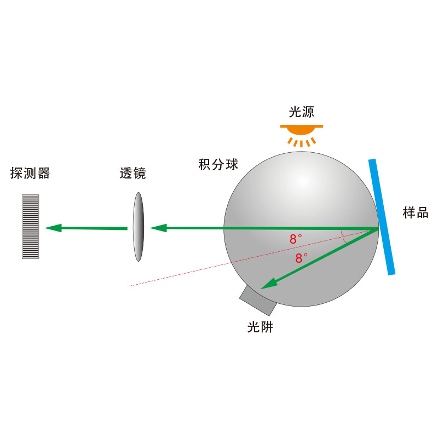
13. D/8 SCI/SCE measurement geometry
D/8 SCI/SCE geometry supports evaluation with specular reflection included or excluded, helping compare samples with different gloss levels and surface textures.
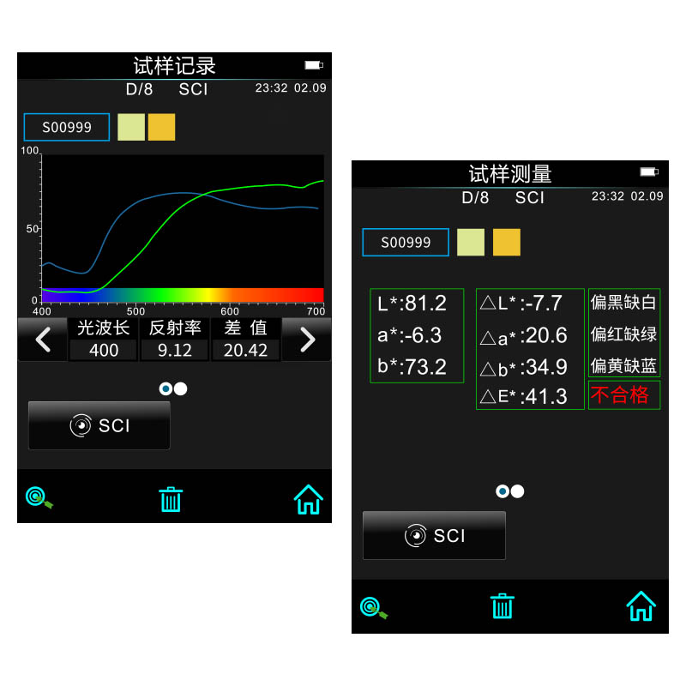
14. Versatile measurement data display
The display can show spectral graphs and data, sample color values, color-difference values and graphs, pass/fail results, color simulation and color bias for review and quality tracking.
15. SQCX quality software and app
The instrument can be paired with SQCX quality-management software and an app for color-data management, color-difference comparison and report organization. Confirm available functions and synchronization by supplied software version.
Compare Models and Choose a Configuration
Start with whether you need dual apertures, camera positioning, SCI/SCE comparison, color-card search, field inspection and data management. For these requirements, evaluate the CR9. For routine incoming inspection, in-process checks and batch color comparison, compare the CR8 and CR7 based on aperture and data workflow.
For entry-level handheld spectrophotometry, consider the TS7010 or TS7020. Before selecting a higher-level configuration, define the measurement geometry, sample material, gloss, aperture and acceptance standard.
CR9 SpectrophotometerSCI/SCE Measurement ModesLab Color Data and ΔEGet CR9 Selection AdviceHandheld SpectrophotometersColor Measurement EquipmentSCI/SCECR9CR8CR7TS7010TS7020Color Measurement EquipmentSpectrophotometersSCI/SCE MeasurementLab and ΔEContact Fulcrum TechnologyGet Configuration and Measurement Advice
To confirm whether the CR9 fits your application, share the sample type, surface and gloss, measurement area, required standards, current inspection workflow and data-storage needs. Fulcrum Technology can help review the selection and configuration.
CR9 Spectrophotometer Specifications
Use these specifications to evaluate the CR9 for selection, purchasing and quality-control integration. The CR9 features D/8 geometry, dual Ø8 mm and Ø4 mm platform apertures, SCI/SCE measurement, CCD viewfinder positioning, Lab color data, color-difference formulas and color-chart retrieval for incoming inspection, in-process checks, R&D comparisons and routine color QC. Confirm the configuration against sample size, surface condition, measurement area, gloss and your internal QC workflow.
| Product model | CR9 Spectrophotometer |
|---|---|
| Measurement geometry | D/8 (diffuse illumination, 8° directional reception); SCI/SCE measurement; complies with CIE No. 15, GB/T 3978, GB 2893, GB/T 18833, ISO 7724-1, ASTM E1164 and DIN 5033 Part 7 |
| Detector | Silicon photodiode array (dual 32-array sensor) |
| Spectroscopic method | Plane grating spectroscopy |
| Integrating sphere | Φ40 mm |
| Light source | Full-spectrum combined LED light source |
| Wavelength range | 400–700 nm |
| Illuminants | D65, A, C, D50, D55, D75, F1, F2 (CWF), F3, F4, F5, F6, F7 (DLF), F8, F9, F10 (TPL5), F11 (TL84), F12 (TL83 / U30) |
| Resolution | 0.01 |
| Wavelength interval | 10 nm |
| Reflectance range | Measures reflectance at three user-specified wavelengths (default: 440, 550 and 600 nm); the app supports full-spectrum wavelength display. Display and data-export options depend on the software/app version. |
| Measurement apertures | Φ8 mm and Φ4 mm |
| Specular component | SCI / SCE |
| Color spaces | CIE LAB, XYZ, Yxy and LCh |
| Color-difference formulas | ΔE*ab and ΔE*00 |
| Other colorimetric indices | WI (ASTM E313, CIE/ISO, AATCC, Hunter), YI (ASTM D1925, ASTM E313), metamerism index (Mt), staining fastness, color-change fastness, color strength, opacity and color-chart retrieval |
| Observer angles | 2° / 10° |
| Displayed parameters | Reflectance at three user-specified wavelengths, sample chromaticity values, color-difference values/graphs, pass/fail results, color simulation and color bias |
| Measurement time | Approx. 1.5 s |
| Repeatability | Chromaticity value: MAV / SCI, ΔE*ab ≤ 0.03 (average of 30 white-tile measurements at 5-second intervals after warm-up and calibration) |
| Inter-instrument difference | MAV / SCI, ΔE*ab ≤ 0.3 (average of measurements on 12 BCRA Series II color tiles) |
| Measurement modes | Single or average measurement (2–99 readings) |
| Positioning | CCD viewfinder / stabilizer positioning |
| Dimensions | Length × width × height = 81 × 71 × 214 mm |
| Weight | 460 g |
| Battery | Rechargeable lithium battery |
| Light-source lifetime | Approx. 5 years or more than 1.5 million measurements |
| Display | 3.5-inch TFT full-color capacitive touchscreen |
| Connectivity | Type-C USB (charging only); Bluetooth 5.0 |
| Data storage | 500 standard samples and 10,000 test samples |
| Software support | Windows; confirm app and data-management functions for the supplied version |
| Languages | Traditional Chinese, Simplified Chinese and English |
| Operating conditions | 0–40°C; 0–85% relative humidity (non-condensing) |
| Storage conditions | -20–50°C (non-condensing) |
| Standard accessories | Power adapter, data cable, manual, SQCX software or related data-management software, black/white calibration box, protective cover, wrist strap, and Ø8 mm/Ø4 mm platform apertures. Actual accessories depend on the supplied version. |
| Optional accessories | Mini printer, powder test box and storage base; confirm options before purchase. |
Selection note: The CR9 is an entry-level handheld spectrophotometer with dual apertures. It is intended for workflows that need Ø8 mm/Ø4 mm switching, CCD viewfinder positioning, color-chart retrieval and routine QC data management. For small, curved or textured samples, varying gloss or multiple suppliers, provide sample conditions, inspection goals and acceptance criteria so the aperture, SCI/SCE conditions and data-management workflow can be confirmed.