


FTZ7 Spectrophotometer (Dual Aperture)
Product Overview
FTZ7 Spectrophotometer | Dual Aperture, SCI/SCE and Color Quality Control
FTZ7 Spectrophotometer is a 3nh handheld spectrophotometer in the high-end handheld spectrophotometer series , using D/8 geometry and supporting SCI/SCE measurement, with a full-spectrum balanced LED source, grating-based spectral analysis and dual 24-element silicon photodiode arrays.
FTZ7 offers Φ12 mm and Φ8 mm apertures, which can be assessed based on sample size, surface condition and QC requirements. It suits plastics, coatings, inks, textile dyeing and printing, ceramics and related industries for Lab color data and ΔE color-difference evaluation, incoming inspection, R&D comparison and process quality control. Confirm selection based on sample material, measurement area, gloss differences, aperture needs and the internal QC workflow.
Key Features
FTZ7 Spectrophotometer Features
Designed for dual-aperture measurement, SCI/SCE comparison, on-site decisions and color data management.
Ergonomic Design
The grip and measurement button placement support handheld operation in R&D, quality control and on-site inspection.
Full-spectrum Balanced LED Source
Provides visible-range spectral distribution and stable illumination conditions for color comparison workflows.
Dual 24-array Sensor
The dual 24-array silicon photodiode sensor supports low-light detection, spectral response and measurement stability; results depend on the sample and workflow.
Grating Spectrometry
Enables spectral analysis for reflectance, color difference and color comparison under multiple illuminants.
Protective Instrument Stand
Supports daily storage and white-tile protection, helping reduce risks from dust or impact.
Professional White Tile
Used with routine calibration and measurement procedures to help maintain consistent test conditions.
Charging and Battery Management
Charging and low-voltage reminders support daily inspections and batch measurements; runtime depends on use.
Dual-aperture Measurement
Choose Φ12 mm or Φ8 mm according to sample size, uniformity and measurement location.
Repeatability and Inter-instrument Agreement
Evaluate using MAV/SCI and standard procedures; application results depend on the sample, calibration and operation.
Color Spaces and Illuminants
Supports CIE LAB, XYZ, Yxy, LCh, s-RGB, βxy, DIN Lab9, DIN Lab99, Munsell (C/2) and multiple illuminants.
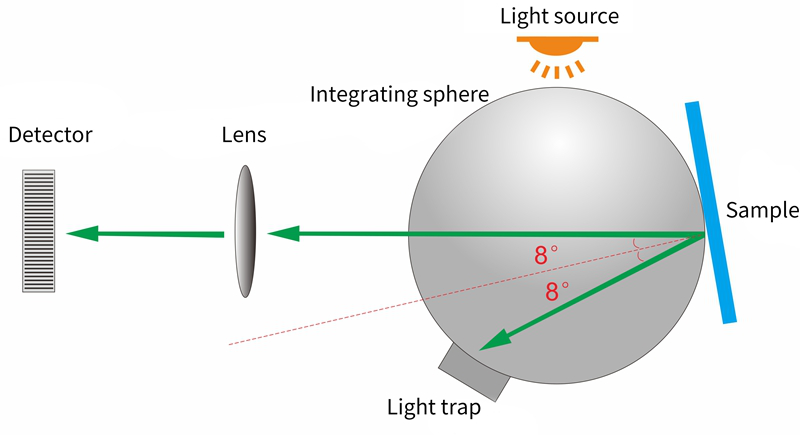
D/8 SCI/SCE Measurement
Using D/8 geometry (SCI/SCE measurement) to compare color with specular reflection included or excluded, especially for samples with different gloss or texture.
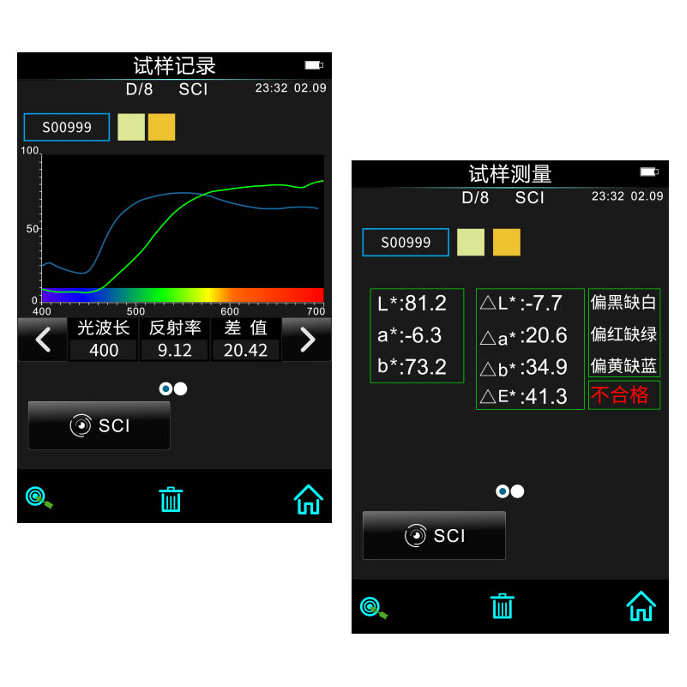
Versatile Data Display
Displays reflectance, sample color values, color difference values/charts, pass/fail results, color simulation and color bias.
Standalone, SQCX Software and APP
Use the instrument standalone or with SQCX quality-management software and the APP for data management, color comparison and quality monitoring. Functions depend on the supplied version.
Selection Guide
How FTZ7 Compares with Other High-End Spectrophotometers
Compare apertures, sample size, small-area measurement, special measurement points and data-management needs.
FTZ7 | Dual Aperture
For general flat samples, larger measurement areas and on-site inspection using FTZ7 Spectrophotometer.
FTZ8 | Three Apertures and 4 mm
Consider FTZ8 when a FTZ8 Spectrophotometer is needed to evaluate small areas or local measurement points.
FTZ9 | Four Apertures and 1 × 3 mm Spot
For narrow surfaces, small parts or special local measurement points requiring a FTZ9 Spectrophotometer.
FTS7000 / Aurora | Multiple Apertures and Advanced Color Management
For more apertures, UV illumination or evaluation of a wider range of samples, compare FTS7000 Spectrophotometer or Aurora Array Spectrophotometer.
FAQ
FTZ7 Frequently Asked Questions
Key questions to confirm before introducing dual-aperture SCI/SCE color quality control.
Which industries and samples can FTZ7 support?
It can be evaluated for plastics, coatings, inks, textile dyeing and printing, print, ceramics, packaging materials, R&D and quality control. Confirm suitability for the sample and measurement conditions.
How should I choose between the two apertures?
Φ12 mm can suit larger measurement areas and more uniform samples; Φ8 mm fits many common sample sizes. Confirm against the sample, measurement point and acceptance standard.
How does FTZ7 differ from FTZ8?
FTZ7 has Φ12 mm and Φ8 mm apertures. FTZ8 adds Φ4 mm for evaluating smaller areas or local measurement points.
When should I use SCI/SCE?
SCI/SCE measurementSCI/SCE evaluates the effect of specular reflection on color data. Confirm customer standards for glossy, matte, coated, textured or differently glossy samples.
How does FTZ7 differ from a basic colorimeter?
General colorimeters are commonly used for quick color-difference checks. FTZ7 is a spectrophotometer that provides spectral reflectance and a broader range of color spaces, along with Lab color data and ΔE color-difference evaluation, while supporting SCI/SCE. Consider FTZ7 for R&D data, supply-chain acceptance or quality traceability.
What information should I provide before adopting FTZ7?
Provide the sample material, dimensions and measurement point, surface gloss, texture or curvature, color-difference formula, illuminant, acceptance criteria, SCI/SCE requirements, and data-storage, app or software needs to confirm an appropriate aperture and workflow.
Confirm Before Selection
The FTZ7 dual-aperture model suits general samples and larger measurement areas for routine color quality control. For small-area, curved or textured samples, gloss differences or varied sample sizes, provide the sample conditions, inspection purpose and internal criteria so the aperture, SCI/SCE conditions and data-management approach can be confirmed.
Contact Fulcrum Technology for FTZ7 Selection AdviceFTZ7 Spectrophotometer Specifications
| Specification | Details |
|---|---|
| Model | FTZ7 Basic Spectrophotometer |
| Measurement Geometry | D/8 (diffuse illumination, 8° viewing); SCI/SCE; conforms to CIE No.15, GB/T 3978, GB 2893, GB/T 18833, ISO 7724-1, ASTM E1164, DIN 5033 Teil7 |
| Sensor | Silicon photodiode array (dual row, 32 groups) |
| Focusing | Electronic focusing |
| Spectral System | Plane grating spectrometry |
| Integrating Sphere | Φ40 mm |
| Illumination Source | Combined full-spectrum LED source |
| Wavelength Range | 400–700 nm |
| Observer Illuminants | D65, A, C, D50, D55, D75, F1, F2 (CWF), F3, F4, F5, F6, F7 (DLF), F8, F9, F10 (TPL5), F11 (TL84), F12 (TL83/U30) |
| Resolution | 0.01 |
| Wavelength Interval | 10 nm |
| Reflectance Range | 0–200% |
| Measurement Apertures | Φ12 mm, Φ8 mm |
| Measurement Mode | SCI/SCE |
| Color Spaces | CIE LAB, XYZ, Yxy, LCh, s-RGB, βxy, DIN Lab9, DIN Lab99, Munsell (C/2) |
| Color Difference Formulas | ΔE*ab, ΔE*94, ΔE*cmc (2:1), ΔE*cmc (1:1), ΔE*00, DIN ΔE99 |
| Other Colorimetric Indices | WI (ASTM E313, CIE/ISO, AATCC, Hunter), YI (ASTM D1925, ASTM 313), metamerism index Mt, staining fastness, color fastness, tinting strength, hiding power, color-card search |
| Observer Angle | 2°/10° |
| Displayed Parameters | Spectral curve/data, sample color values, color difference values/chart, pass/fail result, color simulation, color bias |
| Measurement Time | Approx. 1.5 s |
| Repeatability | Chromaticity: MAV/SCI, ΔE*ab ≤0.04 (after warm-up and calibration; average of 30 white-tile measurements at 5-second intervals) |
| Inter-instrument Agreement | MAV/SCI, ΔE*ab ≤0.4 (average measurement of 12 BCRA Series II color tiles) |
| Measurement Method | Single measurement; average measurement (2–99 times) |
| Positioning | CCD lens, stable-sheet positioning |
| Dimensions | Length × width × height = 81 × 71 × 214 mm |
| Weight | 460 g |
| Battery | Rechargeable lithium battery |
| Light Source Life | Approx. 5 years, more than 3 million measurements |
| Display | 3.5-inch TFT full-color capacitive touch screen |
| Connection | USB |
| Data Storage | 1,000 standards; 20,000 samples |
| Software | Windows |
| Languages | Traditional Chinese, Simplified Chinese, English |
| Operating Conditions | 0–40°C; 0–85% relative humidity (non-condensing) |
| Storage Temperature | -20–50°C (non-condensing) |
| Standard Accessories | Power supply, data cable, manual, SQCX quality-control software (download from official website), black and white calibration box, protective cover, wrist strap, dual-aperture platform: Ø12 mm + Ø8 mm |
| Optional Accessories | Mini printer, powder test box, instrument stand |
Selection note: The dual-aperture basic model suits general samples, larger measurement areas and routine color quality control. For small, curved or textured samples, noticeable gloss differences, fluorescent samples or samples from multiple suppliers, provide sample details to confirm aperture, SCI/SCE and data-management requirements. Specifications are compiled from current product information; confirm the supplied version with the manufacturer or Fulcrum Technology.
Related Products
The TS-26D benchtop spectrophotometer uses D/8 geometry with SCI/SCE measurement and a combined full-spectrum LED and UV light source. Choose among three apertures—MAV Φ8/Φ10 mm, SAV Φ4/Φ5 mm, or SSAV 1 × 3 mm—to suit the sample and measurement area. It supports spectral reflectance, L*a*b* values and ΔE color assessment for plastics, electronics, coatings, inks, textiles, printing, ceramics, packaging, R&D and quality control. Confirm aperture, UV settings and SCI/SCE conditions against your sample and inspection standards.
For configuration or measurement-method guidance, contact Fulcrum Technology.
The TS-25D horizontal spectrophotometer features D/8 optical geometry, a dual optical path, a combined full-spectrum LED and UV light source, and SCI/SCE measurement modes. Select the Φ8 mm or Φ4 mm measuring aperture before purchase. It is designed for color analysis in laboratories, color-standard setup, incoming material inspection, and traceable quality control in production.
The TS-25D can be evaluated for color inspection in plastics and electronics, paints and inks, textiles and dyeing, printing, ceramics, packaging materials, research, and quality control. It supports spectral data and L*a*b*/ΔE color-difference evaluation for supplier acceptance and color-standard management. For fluorescent or optical-brightener-containing samples, or samples requiring special illumination, confirm the measurement method against the sample, applicable standard, aperture, and internal QC procedure.
For product configuration or measurement guidance, contact Fulcrum Technology.