


FTZ8 Spectrophotometer (Three Measurement Apertures)
FTZ8 Spectrophotometer | Three Apertures, SCI/SCE and Color Quality Control
FTZ8 Spectrophotometer is a high-end handheld spectrophotometer from 3nh in the high-end handheld spectrophotometer range. It uses D/8 geometry, supports SCI/SCE measurement modes, and features a full-spectrum balanced LED source, grating-based spectral analysis, and dual 32-element silicon photodiode arrays.
The FTZ8 offers Φ12 mm, Φ8 mm, and Φ4 mm measurement apertures. Evaluate the aperture according to sample size, surface condition, and QC criteria. It is suited to plastics, coatings, inks, textile dyeing and printing, printing, ceramics, and related industries for Lab color data and ΔE color-difference evaluation, incoming inspection, R&D comparison, and process quality control. Confirm selection based on the sample material, measurement area, gloss, aperture requirements, and internal QC workflow.
FTZ8 Key Features
Three Measurement Apertures
Three apertures—Φ12 mm, Φ8 mm, and Φ4 mm—can be evaluated according to sample size, measurement area, and QC criteria.
D/8 and SCI/SCE
D/8 geometry with SCI/SCE modes supports color workflows that compare measurements with and without the effect of gloss.
Grating Spectral Analysis and Dual 32-Element Arrays
Grating-based spectral analysis and dual 32-element silicon photodiode arrays provide a basis for spectral reflectance, color data, and batch comparisons.
Color Library and Data Management
Depending on the supplied configuration, SQCX quality-management software and an app may support data management, color-difference comparisons, and color-library searches.
What Applications Is FTZ8 Suited For?
Routine Color QC and Incoming Inspection
For routine color checks, incoming acceptance, and batch color-difference comparisons on plastics, coatings, inks, textiles, printed materials, ceramics, and packaging.
Three-Aperture Sample Measurement
Evaluate Φ12 mm, Φ8 mm, and Φ4 mm apertures according to sample area and spot size, from general flat samples to smaller or localized measurement areas.
SCI/SCE and Gloss Comparison
For glossy or matte samples, coatings, textures, or varying gloss, assess SCI/SCE conditions to establish a more consistent internal evaluation workflow.
R&D Comparison and Data Traceability
Suitable for formulation development, standard-color creation, supplier batch comparisons, and quality-data traceability. Confirm the color-difference formula, illuminant, and measurement conditions when customer acceptance criteria apply.
FTZ8 Feature Details
Ergonomic Handheld Design
The grip and measurement button are arranged for handheld operation in R&D, quality control, and on-site inspections. Confirm handling procedures for the sample and measurement workflow.
Full-Spectrum Balanced LED Light Source
The full-spectrum balanced LED source provides a basis for visible-range spectral distribution, stable illumination, and color comparison in routine QC and batch workflows.
Dual 32-Element Sensor Arrays
Dual 32-element silicon photodiode arrays provide a basis for spectral data acquisition, color evaluation, and batch comparisons. Actual performance depends on sample conditions, calibration status, and QC procedures.
Grating-Based Spectral Analysis
Grating-based spectral analysis supports the resolution required for spectrophotometry and comparisons of spectral reflectance and color differences under multiple illuminants.
Storage Stand
A storage stand helps keep the instrument in place and protect the white calibration tile, reducing contamination or impact during storage. Follow the manufacturer’s instructions and site procedures.
Professional White Calibration Tile
The included white tile can be used in routine calibration and measurement workflows to help maintain consistent conditions. Follow the manufacturer’s guidance for storage, cleaning, and calibration frequency.
Charging and Battery Management
Charging and low-battery reminders support routine inspections and multi-batch measurements. Actual runtime and charging conditions depend on usage.
Three-Aperture Measurement Design
The FTZ8 offers Φ12 mm, Φ8 mm, and Φ4 mm apertures. Choose according to sample size, measurement area, QC criteria, and measurement-spot conditions.
CCD Viewfinder and Positioning
The built-in CCD viewfinder provides a live view of the target area to help center the measurement and reduce variation caused by positioning shifts. Confirm positioning for the sample shape and measurement spot.
Color Library and Data Search
The instrument stores standard and sample data. Depending on the supplied version, an app may support color-data searches and comparisons. Confirm library, synchronization, and supported functions for the supplied software.
Instrument Agreement and Repeatability
Product data can be used to assess the FTZ8 for instrument-to-instrument consistency, formulation comparison, and color communication. Actual performance depends on samples, calibration, and procedures.
Color Spaces and Illuminants
Supports color spaces including CIE LAB, XYZ, Yxy, LCh, s-RGB, βxy, and Munsell, with multiple illuminant conditions for comparison. Confirm available options for the instrument and software version.
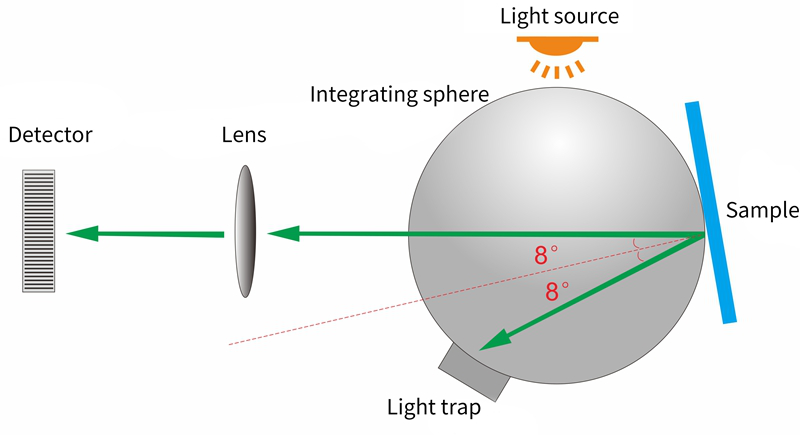
D/8 SCI/SCE Measurement Geometry
Uses D/8 (SCI/SCE measurement) geometry to compare color with or without the specular component, as needed for samples with different gloss levels and textures.
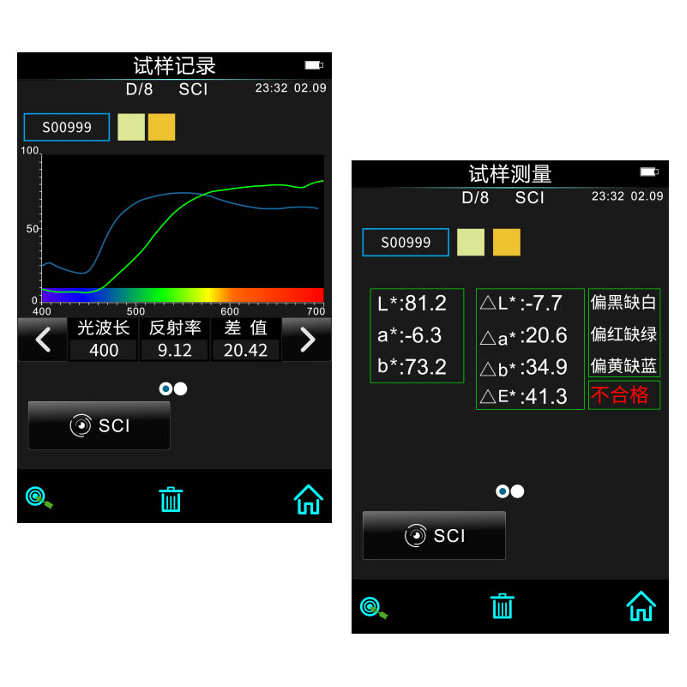
Versatile Data Display
The FTZ8 can display reflectance, sample color values, color differences and graphs, pass/fail results, color simulation, and color direction to support on-site decisions, R&D comparisons, and QC traceability.
Standalone, SQCX Software, and App Use
Use the instrument standalone or, depending on the supplied version, with SQCX quality-management software and an app for data management, color-difference comparisons, and QC monitoring. Confirm software functions and synchronization for the supplied version.
How Does FTZ8 Compare with Other High-End Spectrophotometers?
If your priority is three apertures (Φ12 mm, Φ8 mm, and Φ4 mm), handheld operation, on-site inspection, and routine color QC, consider the FTZ8 Spectrophotometer. For narrow surfaces, small parts, or specialized local measurement spots requiring a 1 × 3 mm aperture, compare the FTZ9 Spectrophotometer. For five apertures, a UV light source, SCI/SCE, and advanced color management, compare the FTS7000 Spectrophotometer. For varied sample sizes, curved or small areas, or specialized measurement spots that may require nine apertures, consider the Aurora Array Spectrophotometer. Confirm selection based on sample size, measurement area, surface condition, inspection goals, and QC workflow.
FTZ8 Frequently Asked Questions
Q1: Which industries and samples are suitable for FTZ8?
FTZ8 can be evaluated for spectrophotometric color measurement in plastics, coatings, inks, textiles, printing, ceramics, packaging, and R&D quality control. For curved or small areas, textures, gloss differences, or samples from different batches, share sample details to confirm the aperture and workflow.
Q2: How should I choose among the three FTZ8 apertures?
Φ12 mm may suit larger, more uniform areas; Φ8 mm is suitable for general color QC; and Φ4 mm can be considered for smaller or localized areas. Confirm the choice based on sample size, surface uniformity, spot location, and internal acceptance criteria.
Q3: When should I use the FTZ8 SCI/SCE modes?
SCI/SCE measurement helps determine whether surface specular reflection is included in color data. SCI compares color with the specular component included; SCE excludes it and can better reflect visual appearance. Confirm the mode against customer requirements for glossy, matte, coated, textured, or varying-gloss samples.
Q4: How does FTZ8 differ from a standard colorimeter?
A standard colorimeter is often used for quick color-difference checks. FTZ8 is a spectrophotometer that provides spectral reflectance, additional color spaces, and Lab color data and ΔE evaluation, and supports multiple apertures and SCI/SCE conditions. Consider FTZ8 for R&D data, supply-chain acceptance, or QC traceability.
Q5: Is FTZ8 suitable for on-site or incoming inspection?
The handheld FTZ8 can be evaluated for on-site inspections, incoming inspection, and multi-batch sampling. If the spot must be highly repeatable or the sample is small or uneven, establish a fixed workflow and determine whether a fixture or averaging is needed.
Q6: What information should I provide before selecting FTZ8?
Provide the sample material and size, spot size, gloss, texture or curvature, current color-difference formula, illuminant, acceptance criteria, SCI/SCE requirements, and data, app, or software needs to help confirm the aperture and workflow.
Need help confirming whether FTZ8 fits your three-aperture color QC workflow?
Share the sample material, spot size, surface condition, texture or curvature, SCI/SCE conditions, color-difference formula, customer criteria, and data-management needs. Fulcrum Technology can help assess FTZ8 or another 3nh high-end spectrophotometer.
Contact Fulcrum Technology for a Quote and Selection AdviceFTZ8 Spectrophotometer Specifications
| Model | FTZ8 Professional Spectrophotometer |
|---|---|
| Measurement Geometry | D/8 (diffuse illumination, 8° directional viewing); SCI/SCE measurement; standards: CIE No. 15, GB/T 3978, GB 2893, GB/T 18833, ISO 7724-1, ASTM E1164, DIN 5033 Part 7 |
| Detector | Silicon photodiode arrays (dual rows of 32 elements) |
| Focusing Method | Electronic and optical focusing |
| Spectral Analysis Method | Planar grating |
| Integrating Sphere Diameter | Φ40 mm |
| Illumination Sources | Combined full-spectrum LED and UV light sources |
| Wavelength Range | 400–700 nm |
| Illuminants | D65, A, C, D50, D55, D75, F1, F2 (CWF), F3, F4, F5, F6, F7 (DLF), F8, F9, F10 (TPL5), F11 (TL84), F12 (TL83 / U30) |
| Resolution | 0.01 |
| Wavelength Interval | 10 nm |
| Reflectance Range | 0–200% |
| Measurement Apertures | Φ12 mm, Φ8 mm, Φ4 mm |
| Specular Component Mode | SCI / SCE |
| Color Spaces | CIE LAB, XYZ, Yxy, LCh, CIE LUV, s-RGB, βxy, DIN Lab9, DIN Lab99, Munsell (C/2) |
| Color-Difference Formulas | ΔE*ab, ΔE*uv, ΔE*94, ΔE*cmc (2:1), ΔE*cmc (1:1), ΔE*00, DIN ΔE99 |
| Other Colorimetric Indices | WI (ASTM E313, CIE/ISO, AATCC, Hunter), YI (ASTM D1925, ASTM 313), metamerism index Mt, staining fastness, color-change fastness, color strength, opacity, color-library search |
| Observer Angle | 2° / 10° |
| Displayed Parameters | Spectral graph / data, sample color values, color difference / graph, pass / fail results, color simulation, color direction |
| Measurement Time | Approx. 1.5 seconds |
| Repeatability | Color values: MAV / SCI, ΔE*ab ≤ 0.03 (after warm-up and calibration; average of 30 white-tile measurements at 5-second intervals) |
| Instrument Agreement | MAV / SCI, ΔE*ab ≤ 0.35 (average across 12 BCRA Series II color tiles) |
| Measurement Modes | Single measurement; average measurement (2–99 readings) |
| Positioning | CCD camera and stabilizing-plate positioning |
| Dimensions | L × W × H = 81 × 71 × 214 mm |
| Weight | 460 g |
| Battery | Rechargeable lithium battery |
| Light Source Life | Approx. 5 years or more than 3 million measurements |
| Display | 3.5-inch full-color TFT capacitive touchscreen |
| Connectivity | USB, Bluetooth 5.0 |
| Data Storage | 1,000 standard samples; 20,000 measured samples |
| Software Compatibility | Windows, iOS, Android |
| Languages | Traditional Chinese, Simplified Chinese, English |
| Operating Conditions | 0–40°C; 0–85% relative humidity (non-condensing) |
| Storage Temperature | −20–50°C (non-condensing) |
| Standard Accessories | Power adapter, data cable, user manual, SQCX quality-management software (download from official website), black-and-white calibration box, protective cover, wrist strap, aperture plates for Φ12 mm + Φ8 mm + Φ4 mm, MOBCCS app (download from official website) |
| Optional Accessories | Mini printer, powder test box, storage stand |
Specifications note: FTZ8 is a professional three-aperture spectrophotometer for general and varied-size samples and color-QC traceability. For curved or textured samples, gloss differences, fluorescence, or samples from multiple suppliers, provide sample details to confirm the suitable aperture, SCI/SCE conditions, and data-management approach. Specifications are compiled from current product information; confirm the applicable version with the manufacturer or Fulcrum Technology.