


FTS7000 Spectrophotometer (5 Apertures)
FTS7000 Spectrophotometer | Five Apertures, UV Source & Advanced Color QC
FTS7000 Spectrophotometer is 3nh’s high-end handheld spectrophotometer, featuring D/8 optical geometry, an array sensor, full-spectrum LED and UV light sources. It supports SCI/SCE measurement modes, spectral reflectance, and Lab color data and ΔE evaluation.
FTS7000 features five apertures: 8 mm flat, 8 mm pointed, 4 mm flat, 4 mm pointed and a miniature 1 × 3 mm aperture. Evaluate the configuration for sample size, measurement area, curved surfaces, localized areas and special measurement points. Applications include electronic plastics, paints and inks, textile dyeing, printing, ceramics, packaging and advanced color QC. Confirm selection based on material, surface, measurement area, gloss, fluorescence and your QC procedure.
FTS7000 Highlights
Five Measurement Apertures
Includes 8 mm flat and pointed, 4 mm flat and pointed, and a miniature 1 × 3 mm aperture. Choose based on sample size, measurement area, curved surfaces, localized areas or narrow points.
UV Measurement Conditions
Evaluate fluorescent materials, optical brighteners and UV-sensitive samples. Select UV-included or UV-excluded measurement according to the inspection objective and sample.
D/8 and SCI/SCE
D/8 geometry and SCI/SCE support color comparison with or without the specular reflection component.
CCD Camera Positioning
View and confirm the measurement area for localized color patches, small areas, printed patterns and specified points. Confirm the aperture and positioning method for the sample.
FTS7000 Applications
Different Sample Sizes and Small Measurement Areas
The five apertures support samples of different sizes, small areas, localized regions and curved surfaces. Select according to sample dimensions and measurement point.
Fluorescent Materials and UV Conditions
The UV source helps evaluate fluorescent or UV-sensitive materials, including optical brighteners, special coatings, paper whiteness and textiles.
Supply-Chain Acceptance and Standard Color Management
Use FTS7000 to establish standard colors, compare batches, accept incoming materials and manage color data across sites. Align the color-difference formula, observer illuminant and SCI/SCE condition with customer acceptance criteria.
R&D Comparison and Process QC
For workflows using spectral data, Lab values and ΔE evaluation with electronic plastics, paints and inks, textiles, printing, ceramics and packaging.
FTS7000 Feature Details
Array Sensor and Spectral Measurement
Manufacturer materials state that FTS7000 uses a large-area dual-row 40-element photodiode array sensor for spectral data acquisition, color evaluation and batch comparison. Results depend on the sample, calibration and measurement procedure.
Multi-Platform Color Data Management
Depending on the supplied version, HarmonyOS, Android, iOS, WeChat Mini Program or Windows software may be available for color-data management, difference comparison and report export, supporting supplier-batch comparison, internal color standards and QC traceability.
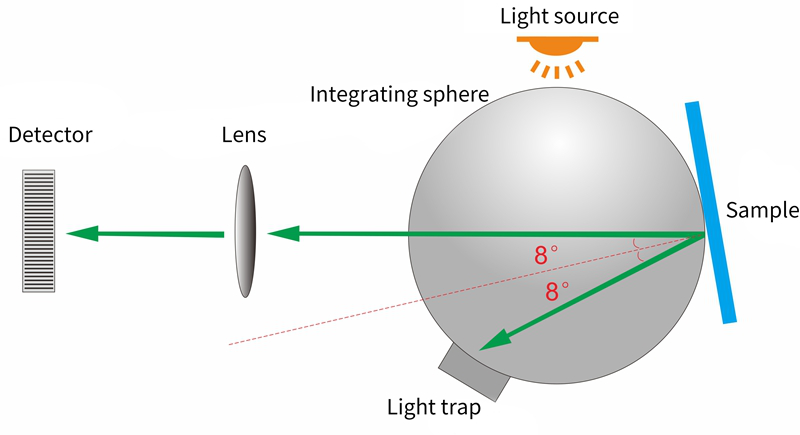
D/8 Geometry and SCI/SCE Measurement
D/8 geometry supports reflected-color measurement. SCI/SCE compare color with or without specular reflection. Confirm the measurement condition in your internal standard for glossy, matte, coated or textured samples.
Full-Spectrum LED and UV Sources
Full-spectrum LED and UV sources support evaluation of ordinary reflected color, fluorescent materials, optical brighteners and special coatings. Choose UV-included or UV-excluded measurement for the objective, sample and customer requirements.
Five-Aperture Configuration
FTS7000 has 8 mm flat and pointed, 4 mm flat and pointed, and a miniature 1 × 3 mm aperture. Evaluate for large or small areas, curved surfaces, narrow sections or localized points. Confirm the aperture for the actual sample.
CCD Camera Positioning
The built-in camera provides a live view of the measurement area so the operator can check whether the target is centered. For localized color patches, printed patterns, small areas or specified points, confirm both aperture and positioning method.
Black-and-White Calibration Tube
Depending on the supplied version, non-contact automatic calibration and a dedicated white tile may be available to support consistent daily measurements. Follow manufacturer guidance and QC procedures for tile care, cleaning and calibration frequency.
Base and White-Tile Protection
The base helps store the instrument and protect the white tile, reducing contamination that may affect daily calibration and measurement stability. Follow manufacturer instructions and site QC procedures.
Multiple Color Spaces and Observer Illuminants
Available evaluations may include CIE LAB, XYZ, Yxy, LCh, CIE LUV, s-RGB, HunterLab, DIN Lab99 and Munsell, with D65, A, C, D50, D55, D75, F-series and LED illuminants. Confirm availability for the instrument settings and software version.
Inter-Instrument Difference and Repeatability
Manufacturer materials describe inter-instrument and repeatability control. Evaluate multi-instrument comparison, cross-site color management and long-term QC against calibration, sample and measurement procedures.
How FTS7000 Compares with Other High-End Spectrophotometers
If five apertures, a UV source, CCD camera positioning, D/8 SCI/SCE and advanced color-data management are priorities, consider FTS7000 Spectrophotometer. For more apertures and special samples, compare Aurora Spectrophotometer; for four apertures, consider FTZ9 Spectrophotometer. Confirm selection based on sample size, measurement area, surface, inspection objective and QC procedure.
FTS7000 FAQs
Q1: Which samples and industries are suitable for FTS7000?
FTS7000 can be evaluated for electronic plastics, paints and inks, textile dyeing, printing, ceramics, packaging and R&D. For samples with small areas, curves, texture, gloss differences, fluorescence or varying sizes, provide sample details to confirm aperture and method.
Q2: How should I choose among FTS7000’s five apertures?
The 8 mm apertures suit samples with sufficient, relatively even measurement areas; 4 mm apertures can be evaluated for smaller or localized areas; the miniature 1 × 3 mm aperture is for narrow, curved or special points. Confirm selection by sample size, measurement area and repeatability needs.
Q3: Can FTS7000 evaluate fluorescent samples?
FTS7000 has a UV source for evaluating fluorescent or UV-sensitive materials. For optical brighteners, special coatings, paper whiteness or textiles, confirm whether UV-included or UV-excluded measurement is required by the applicable standard.
Q4: What is the purpose of SCI/SCE measurement on FTS7000?
SCI includes the specular reflection component; SCE excludes it for an appearance assessment closer to visual observation. For glossy, matte or coated samples and customer acceptance criteria, align whether to use SCI, SCE or both.
Q5: How does FTS7000 differ from a standard handheld colorimeter?
FTS7000 is a spectrophotometer that can provide spectral data, multiple color spaces and color-difference formulas, with multiple apertures, a UV source and SCI/SCE. For quick color-difference checks, consider a standard colorimeter; for supply-chain standards, R&D data or QC traceability, evaluate FTS7000.
Q6: What information should I provide before selecting FTS7000?
Provide the material, sample and measurement-point dimensions, surface, gloss or texture, fluorescence, color-difference formula, observer illuminant, customer acceptance criteria, SCI/SCE or UV needs, and record/report requirements.
Is FTS7000 Right for Your Five-Aperture QC Workflow?
Share your material, measurement-point size, surface, fluorescence, SCI/SCE needs, color-difference formula and acceptance criteria so Fulcrum Technology can help evaluate FTS7000 or another 3nh high-end spectrophotometer.
Contact Fulcrum Technology for a quotation and selection advice841 container mceu_15208-body
FTS7000 Spectrophotometer Specifications
| Product Model | FTS7000 Spectrophotometer |
|---|---|
| Measurement Geometry | D/8 (diffuse illumination, 8° directional observation); SCI/SCE measurement; UV-included / UV-excluded measurement; conforms to CIE No. 15, GB/T 3978, GB 2893, GB/T 18833, ISO 7724-1, ASTM E1164 and DIN 5033 Teil 7 |
| Detector | Silicon photodiode array (dual-row, 40 elements) |
| Spectral System | Flat diffraction grating |
| Integrating Sphere Diameter | Φ40 mm |
| Light Source | Combined full-spectrum LED and UV sources |
| Wavelength Range | 360–780 nm |
| Observer Illuminants | D65, A, C, D50, D55, D75, F1, F2 (CWF), F3, F4, F5, F6, F7 (DLF), F8, F9, F10 (TPL5), F11 (TL84), F12 (TL83 / U30), B, U35, NBF, ID50, ID65, LED-B1, LED-B2, LED-B3, LED-B4, LED-B5, LED-BH1, LED-RGB1, LED-V1, LED-V2, LED-C2, LED-C3 and LED-C5 |
| Wavelength Interval | 10 nm |
| Reflectance Range | 0–200% |
| Measurement Apertures | Five apertures: MAV: Φ8 mm / Φ10 mm; SAV: Φ4 mm / Φ5 mm; LAV: 1 × 3 mm |
| Specular Component Mode | Simultaneous SCI / SCE measurement |
| Color Spaces | CIE LAB, XYZ, Yxy, LCh, CIE LUV, s-RGB, HunterLab, βxy, DIN Lab99 and Munsell (C/2) |
| Color-Difference Formulas | ΔE*ab, ΔE*uv, ΔE*94, ΔE*cmc (2:1), ΔE*cmc (1:1), ΔE*00, DIN ΔE99 and ΔE (Hunter) |
| Other Color Indices | Spectral reflectance; WI (ASTM E313, CIE/ISO, AATCC, Hunter, Taube Berger Stensby); YI (ASTM D1925, ASTM E313); metamerism index Mt; staining and color-change fastness; color strength (dye strength, tinting strength); opacity; 8° gloss; 555 hue classification; blackness (My, dM); CMYK (A, T, E, M); Tint; color density; Munsell |
| Observer Angle | 2° / 10° |
| Displayed Parameters | Spectral curves / data, sample color values, color differences / graphs, pass / fail results, color simulation and color cast |
| Measurement Time | Approx. 1.5 s |
| Repeatability | Color values: MAV / SCI, ΔE*ab within 0.015 (average of 30 white-tile measurements at 5-second intervals after warm-up and calibration); spectral reflectance: MAV / SCI, standard deviation within 0.08% (within 0.18% from 400–700 nm) |
| Inter-Instrument Difference | MAV / SCI, ΔE*ab within 0.15 (average of measurements on 12 BCRA Series II color tiles) |
| Display Resolution | 0.01 |
| Measurement Mode | Single measurement; average measurement (2–99 readings) |
| Positioning | CCD camera positioning; alignment plate positioning |
| Dimensions | 129 × 76 × 217 mm (H × W × D) |
| Weight | 600 g |
| Battery Capacity | Lithium battery, 3.7 V, 5000 mAh; up to 8,800 measurements within 8 hours |
| Light-Source Life | Approx. 10 years; more than 1.5 million measurements |
| Display | 3.5-inch TFT color capacitive touchscreen |
| Connectivity | USB, Bluetooth 5.0 |
| Data Storage | 1,000 standard samples and 30,000 test samples (each record can include SCI / SCE) |
| Software Support | Windows, Android and iOS |
| Languages | Traditional Chinese, Simplified Chinese and English |
| Operating Conditions | 0–40°C; 0–85% relative humidity (non-condensing) |
| Storage Conditions | -20–50°C (non-condensing) |
| Standard Accessories | Power adapter, data cable, user manual, QC software (website download), black-and-white calibration box, protective cover, wrist strap, Ø8 mm flat aperture, Ø8 mm pointed aperture, Ø4 mm flat aperture, Ø4 mm pointed aperture and 1 × 3 mm pointed aperture |
| Optional Accessories | Mini printer; powder test box |
Specification note: FTS7000 is a high-end five-aperture spectrophotometer for samples of different sizes, small-area measurement, fluorescent-material evaluation and color-QC traceability. For curved or textured surfaces, gloss differences or multiple suppliers, provide sample information to confirm the aperture, SCI/SCE condition and data-management workflow. Specifications are based on current product information; confirm the applicable version with the manufacturer or Fulcrum Technology.
841 container mceu_15872-body
Related Products
The TS-26D benchtop spectrophotometer uses D/8 geometry with SCI/SCE measurement and a combined full-spectrum LED and UV light source. Choose among three apertures—MAV Φ8/Φ10 mm, SAV Φ4/Φ5 mm, or SSAV 1 × 3 mm—to suit the sample and measurement area. It supports spectral reflectance, L*a*b* values and ΔE color assessment for plastics, electronics, coatings, inks, textiles, printing, ceramics, packaging, R&D and quality control. Confirm aperture, UV settings and SCI/SCE conditions against your sample and inspection standards.
For configuration or measurement-method guidance, contact Fulcrum Technology.
The TS-25D horizontal spectrophotometer features D/8 optical geometry, a dual optical path, a combined full-spectrum LED and UV light source, and SCI/SCE measurement modes. Select the Φ8 mm or Φ4 mm measuring aperture before purchase. It is designed for color analysis in laboratories, color-standard setup, incoming material inspection, and traceable quality control in production.
The TS-25D can be evaluated for color inspection in plastics and electronics, paints and inks, textiles and dyeing, printing, ceramics, packaging materials, research, and quality control. It supports spectral data and L*a*b*/ΔE color-difference evaluation for supplier acceptance and color-standard management. For fluorescent or optical-brightener-containing samples, or samples requiring special illumination, confirm the measurement method against the sample, applicable standard, aperture, and internal QC procedure.
For product configuration or measurement guidance, contact Fulcrum Technology.