

How Does a Colorimeter Work? From Reflected Light to Lab and ΔE
Colorimeter Measurement Principle: XYZ, Lab and Delta E
How Does a Colorimeter Work? How Color Becomes Lab and ΔE
A colorimeter obtains optical information from a sample under defined measurement conditions and converts it into color values that can be recorded and compared. In simple terms: illuminate the sample → receive reflected light → calculate color data.
Key point: a colorimeter does not directly “see” color. It measures an optical signal and applies color calculations to produce XYZ, L*a*b*, ΔE and other supported data.
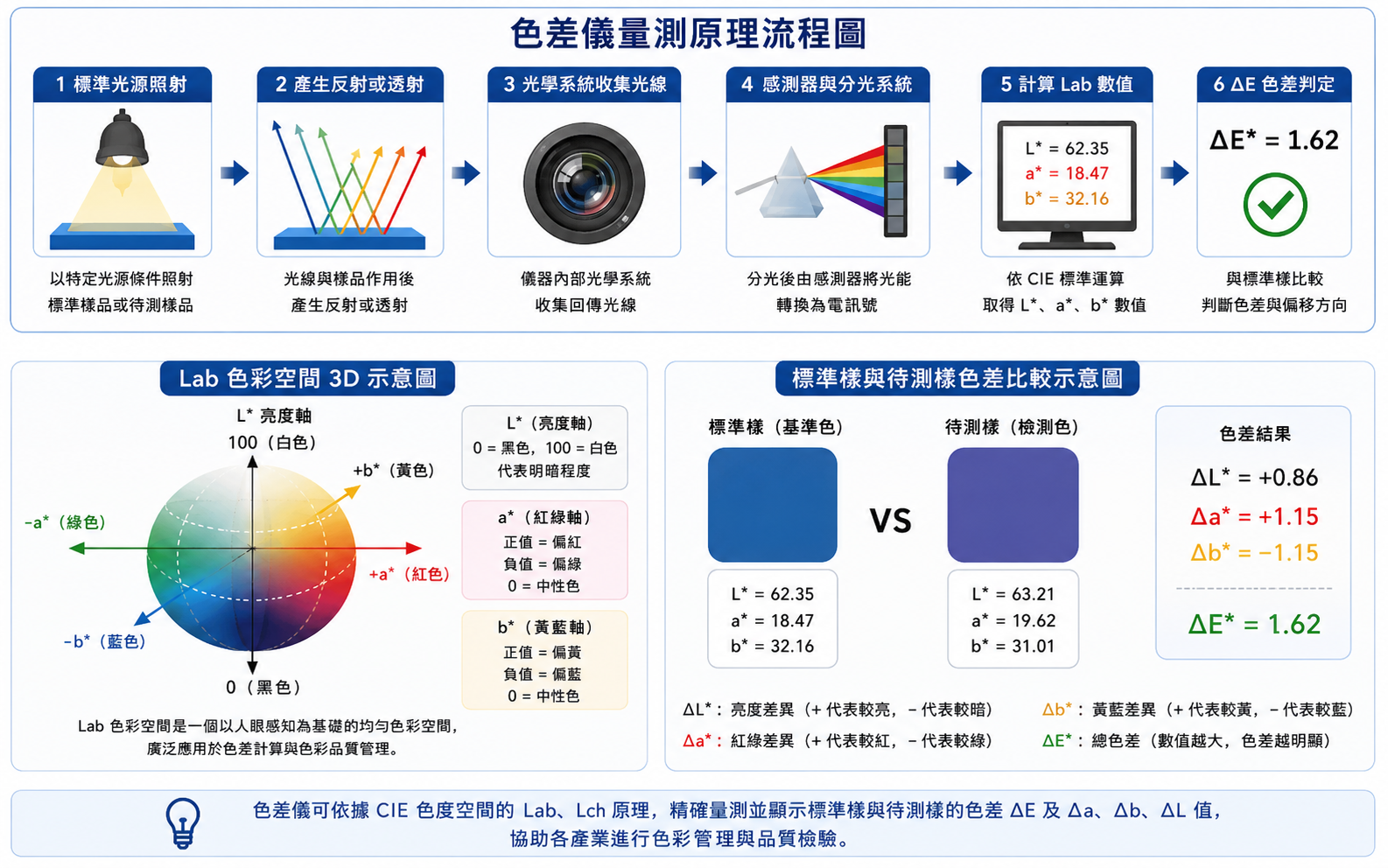
1. How does a colorimeter turn color into numbers?
The color seen by the human eye depends on the light source, how the sample absorbs and reflects light, and viewing conditions. A colorimeter collects reflected-light information under more controlled optical conditions and converts it into color data.
• Illuminate the sample: the instrument uses its designed illumination geometry. Material, pigments, gloss and texture affect the reflected light.
• Receive reflected light: the optical and sensor systems detect the corresponding signal. Optical geometry and sensing methods vary among instrument types.
• Convert to color data: using selected illuminant, observer and color calculation settings, the instrument reports XYZ, L*a*b*, ΔE or other supported data.
2. Why do we get XYZ before L*a*b*?
After collecting the optical signal, a colorimeter does not directly measure L*, a* and b* as raw physical quantities. Color values are calculated through standardized transformations.
• Collect optical information: measure the sample’s reflection or other relevant optical signal.
• Calculate XYZ: convert the measured information into X, Y and Z tristimulus values using the specified standard illuminant and observer.
• Convert to L*a*b*: apply the corresponding calculation to XYZ to obtain L*, a* and b*.
For more on the relationship between XYZ and Lab, see: https://fulcrum-technology.com/cie-1931-to-1976-evolution
3. What role does L*a*b* play?
L*a*b* is a common way to represent color along three directions: lightness, red–green and yellow–blue.
• L*: lightness/darkness.
• a*: red–green direction.
• b*: yellow–blue direction.
For guidance on interpreting L*, a*, b* and ΔL*, Δa*, Δb*, see: https://fulcrum-technology.com/what-is-lab-value

4. Where does ΔE come from?
For a color comparison, first measure or save a standard, then measure the sample. The instrument compares the two sets of color data, reports ΔL*, Δa* and Δb*, and calculates ΔE using the selected color-difference formula.
• Standard: save a color dataset as the comparison reference.
• Test sample: measure another dataset under the same conditions.
• Difference: compare the direction of each axis and the overall color difference.
Learn about ΔE formulas, calculation methods and interpretation: https://fulcrum-technology.com/what-is-color-difference
5. Why can the same sample produce different readings?
Color data depends on more than the sample’s color. Different measurement conditions may produce different results for the same sample.
• Aperture: textured, nonuniform or small samples may yield different representative readings with different apertures.
• Measurement location: results can change on curved, gradient or nonuniform samples.
• Surface: gloss, matte finish, roughness and texture alter reflection.
• SCI/SCE: including or excluding specular reflection can change L*a*b* and ΔE. See https://fulcrum-technology.com/new-sci-sce-difference
• Illuminant and observer: different calculation conditions can produce different values.
• Instrument condition and calibration: instrument status and operating method affect consistency.
6. Why might different colorimeters give different results?
Even if two instruments display L*a*b* and ΔE, their optical geometry, aperture, sensors and calculation settings may not be identical.
• Optical geometry: different illumination/collection designs capture different reflected-light information.
• Aperture: the sampled area differs, especially for textured or nonuniform samples.
• SCI/SCE: specular inclusion affects the values.
• Illuminant and observer settings: different calculation conditions change results.
• Calibration and instrument condition: these affect repeatability and comparisons across instruments.
When comparing instruments, do not rely only on the fact that both show Lab and ΔE. Confirm that measurement conditions match.
7. Is the principle exactly the same for a colorimeter and a spectrophotometer?
Not exactly. Optical geometry, sensing methods and the depth of available data differ by instrument type and design. A general colorimeter is often used to obtain L*a*b* and ΔE quickly, while a spectrophotometer can provide more complete spectral information. For help choosing between them, see https://fulcrum-technology.com/how-to-choose-colorimeter-spectrophotometer
Frequently asked questions
How does a colorimeter measure color? It illuminates a sample under defined optical conditions, receives reflected light and calculates XYZ, L*a*b*, ΔE and other data.
Does a colorimeter directly simulate the human eye? That is an oversimplification. It uses optical and sensor systems to collect measurement data and applies standardized color calculations.
Why can different instruments report different Lab values for one sample? Differences may come from optical geometry, aperture, SCI/SCE, illuminant, observer, calibration or sample positioning.
What is the main principle difference between a colorimeter and spectrophotometer? Designs vary; colorimeters typically focus on quickly reporting color and color-difference values, while spectrophotometers can provide more complete spectral data.
Results do not agree for the same sample?
If different instruments, operators or organizations report different L*a*b* or ΔE values for the same sample, share the instrument models, aperture, SCI/SCE mode, illuminant settings and sample surface condition so the measurement conditions can be compared.
Contact Fulcrum Technology: https://fulcrum-technology.com/contact-us