

How to Choose a Spectrophotometer: 45/0, D/8, Contact and Non-Contact
How to choose 45/0, D/8, contact and non-contact spectrophotometers
Choose a spectrophotometer based on the sample and measurement objective
A common mistake is choosing a spectrophotometer by comparing accuracy, repeatability, or price before confirming the sample type and measurement objective. Plastic housings, coated parts, printed materials, traffic signs, liquids, powders, pastes, and in-line production samples may require different optical geometries.
For samples where surface appearance matters—such as coatings, plastic housings, printed products, reflective films, and traffic signs—consider a 45/0 spectrophotometer. For color matching, incoming inspection, color-standard management, batch comparisons, or SCI/SCE analysis of gloss effects, a D/8 instrument is often considered. For liquids, powders, pastes, food, cosmetics, or samples that should not touch the instrument, consider a non-contact spectrophotometer.
1. Ask three questions before choosing
A suitable spectrophotometer must match the sample and quality-control workflow, not simply produce a color value. The wrong geometry can produce stable readings that do not match visual appearance or customer acceptance.
- What is the sample? Plastic, paint, ink, printed materials, fabric, powder, liquid, paste, or traffic-sign material?
- What is the measurement objective? Appearance acceptance, formula development, incoming inspection, batch control, in-line monitoring, or comparison with a customer standard?
- Can the sample be touched? If it could contaminate the instrument, deform, take an indentation, or needs to be measured on a production line, evaluate non-contact measurement.
First identify the sample and application; then compare 45/0, D/8, contact, and non-contact approaches. This is usually more useful than starting with price or repeatability specifications alone.
2. When is a 45/0 spectrophotometer suitable?
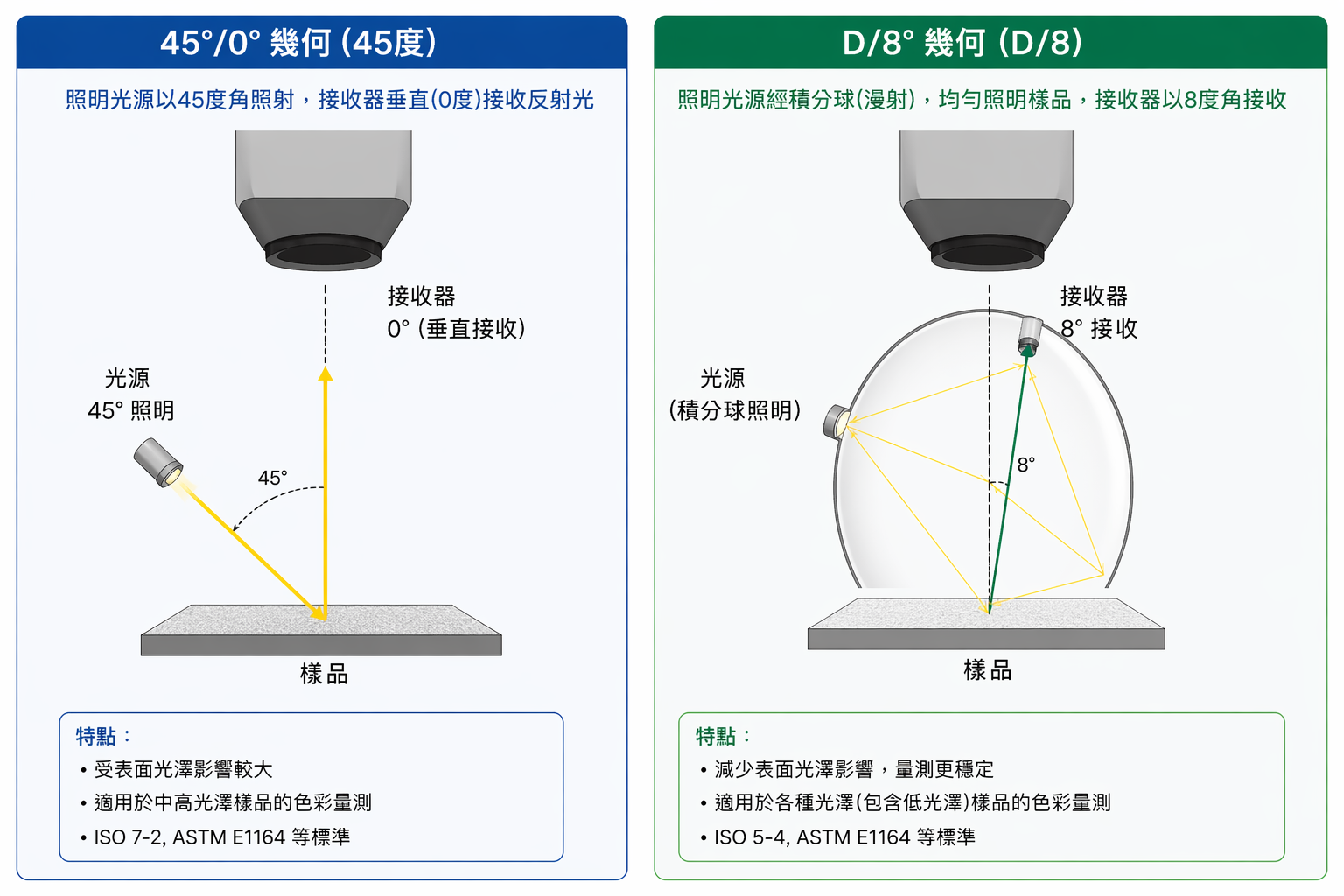
In 45/0 geometry, illumination is at 45 degrees and reflected light is received at 0 degrees. This arrangement can resemble how people view certain surfaces and is often used when visual appearance and surface consistency are important.
Consider 45/0 when acceptance depends on whether a surface looks consistent, including coated parts, plastic housings, printed products, traffic signs, reflective films, and other appearance-critical materials. Common applications include:
- Coatings and plastic appearance parts: Inspect color differences in plastic components, housings, baked enamel, coated surfaces, and finished products.
- Printing and packaging: Compare paper, labels, package printing, inks, and brand colors.
- Traffic signs and reflective materials: Inspect road studs, markings, reflective films, and related standard colors.
- Visual acceptance: Support applications where customers emphasize human visual judgment and consistent finished appearance.
Products to consider: YS4560 45/0 spectrophotometer and YS4560 Plus 45/0 spectrophotometer.
3. When is a D/8 spectrophotometer suitable?
D/8 geometry is commonly used for color matching, material comparison, incoming inspection, and batch color management. When samples have different gloss, texture, or roughness, SCI/SCE modes can help distinguish material color from the effect of surface appearance.
D/8 instruments are common in plastics, coatings, inks, textiles, food, cosmetics, and laboratory quality control. Consider this geometry when you need to establish master samples, track batch color, develop formulations, or compare suppliers. Typical uses include:
- Batch color management for plastics, coatings, inks, textiles, and other materials.
- Formula development, color-standard management, master-sample creation, and incoming inspection.
- Comparing glossy, matte, textured, or differently finished samples using SCI/SCE.
- Establishing shared color standards across laboratories, R&D, quality teams, and suppliers.
Products to consider include the TS8500 benchtop spectrophotometer, Aurora spectrophotometer, and a high-end handheld spectrophotometer.
4. When do you need non-contact measurement?
Consider a non-contact spectrophotometer if a sample should not touch the instrument or if contact could contaminate the device, damage the surface, leave an indentation, or cause cross-contamination. Non-contact color measurement is used for liquids, powders, pastes, food, cosmetics, ceramics, printing, and automated production lines. The objective is to keep a distance between the measurement head and sample and reduce variation caused by handling.
- Liquids and pastes: Food sauces, cosmetic creams, coatings, inks, and wet samples that are unsuitable for direct contact.
- Powders and granules: Food powders, chemical powders, ceramics, powder coatings, and granular materials.
- Contamination-sensitive samples: Samples that may leave residue, adhere to the instrument, or be difficult to clean.
- In-line production: Continuous color monitoring on an automated production line.
Products to consider include the YL4560 45/0 non-contact spectrophotometer and YL4568 in-line 45/0 non-contact spectrophotometer.
5. Comparing 45/0, D/8, and non-contact instruments
- 45/0: Focuses on surface appearance and visual perception. Common samples include coatings, plastic housings, printed products, traffic signs, and reflective materials. Product direction: YS4560 and YS4560 Plus.
- D/8: Suits material color, color matching, and batch comparison; SCI/SCE may be available. Common samples include plastics, coatings, inks, textiles, food, cosmetics, and laboratory samples. Product direction: TS8500, Aurora, and high-end handheld instruments.
- Non-contact: Avoids touching the sample and helps reduce contamination, indentations, residue, and handling effects. Common samples include liquids, powders, pastes, food, cosmetics, and in-line materials. Product direction: YL4560 and YL4568.
No geometry is universally best. The right choice depends on the sample characteristics and purpose of the measurement.
6. What information should you provide before selecting a device?
“I need to measure color” is usually not enough to select an instrument. Industry standards, sample surface, shape, transparency, gloss, and inspection workflow all affect the choice. Prepare the following information:
- Sample material: plastic, coating, ink, textile, paper, food, cosmetics, powder, or liquid.
- Surface condition: glossy, matte, textured, rough, transparent, translucent, or curved.
- Inspection objective: incoming acceptance, process control, formula development, color-standard management, customer acceptance, or in-line monitoring.
- Whether SCI/SCE, UV, fluorescent-sample measurement, multiple apertures, or camera positioning is required.
- Whether the sample can be touched and whether contact could contaminate the instrument.
- Any customer-specified illuminant, viewing angle, color-difference formula, or acceptance limit.