

How Does a Colorimeter Work? Principles, SCI/SCE and ΔE
How Does a Colorimeter Work? Principles, SCI/SCE and ΔE
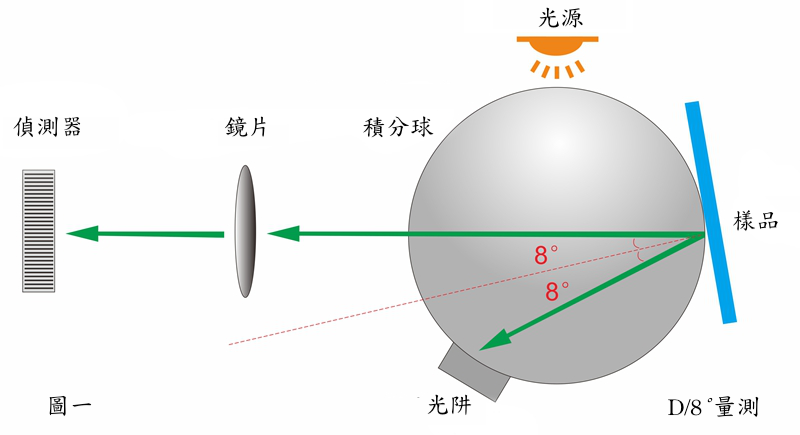

A colorimeter converts reflected or transmitted light into numerical color data. It illuminates a sample with a standardized light source, collects the light through an optical system, and uses a detector and calculation algorithms to report values such as CIE L*a*b* and color difference (ΔE). This makes color inspection more consistent than visual judgment alone.
How does the measurement work?
1. A standardized light source illuminates the sample. D65, which represents average daylight, is commonly used.
2. Light reflected from or transmitted through the sample enters the instrument’s optical system.
3. The detector converts the light into an electrical signal. The instrument calculates tristimulus values (X, Y, Z), chromaticity coordinates (x, y), or CIE L*a*b* values.
D/8 geometry: integrating sphere and SCI/SCE
Many colorimeters and spectrophotometers use 8-degree viewing geometry with diffuse illumination from an integrating sphere (d/8 or D/8). The sphere’s highly reflective diffuse inner surface provides even illumination, while the detector views the sample at 8 degrees. The arrangement is described in standards including CIE No. 15, ISO 7724-1, DIN 5033 Part 7, ASTM E1164, GB/T 3978, and JIS Z8722 Condition C.
SCI (specular component included) includes the specular reflection and is useful for evaluating material color with surface gloss effects reduced. SCE (specular component excluded) excludes the specular reflection, typically using a light trap, and better represents the appearance seen by an observer. Use the measurement mode required by your customer or product specification, and keep it consistent when comparing samples.
Understanding CIE L*a*b* and ΔE
In CIE L*a*b*, L* represents lightness from black (0) to white (100); a* runs from green (negative) to red (positive); and b* runs from blue (negative) to yellow (positive). The differences between a standard and a sample are ΔL*, Δa*, and Δb*. ΔE summarizes the overall size of the color difference, but does not show its direction.
The classic CIE76 equation is ΔE*ab = √[(L*₂−L*₁)² + (a*₂−a*₁)² + (b*₂−b*₁)²]. For example, if the standard is (50, 10, 20) and the sample is (52, 13, 18), ΔE*ab = √17 ≈ 4.12. The sample is lighter, redder, and bluer than the standard.
Different industries may specify different formulas. CIEDE2000 (ΔE00) is widely used for general color evaluation; older specifications may use ΔE*ab; ΔE94 is found in some plastics and coatings requirements; and textiles may use ΔEcmc. Always follow the formula, illuminant, observer angle, geometry, and tolerance stated in the applicable specification.
Where are colorimeters used?
Color measurement supports incoming inspection, production control, and final quality checks in plastics and injection molding, paints and coatings, printing and packaging, textiles and dyeing, food, and cosmetics. A consistent instrument setup helps teams compare samples, communicate tolerances, and identify process drift.
Explore color measurement solutions: Aurora advanced spectrophotometer, TS-26D spectrophotometer, TILO color assessment cabinets, spectrocolorimeters, and colorimeters. For help choosing a solution, contact us. You may also be interested in color-difference data and human visual discrimination.