

Why Do Handheld Spectrophotometer Prices Vary? Entry-Level vs. High-End Models
Handheld Spectrophotometer Price Differences and Buying Guide
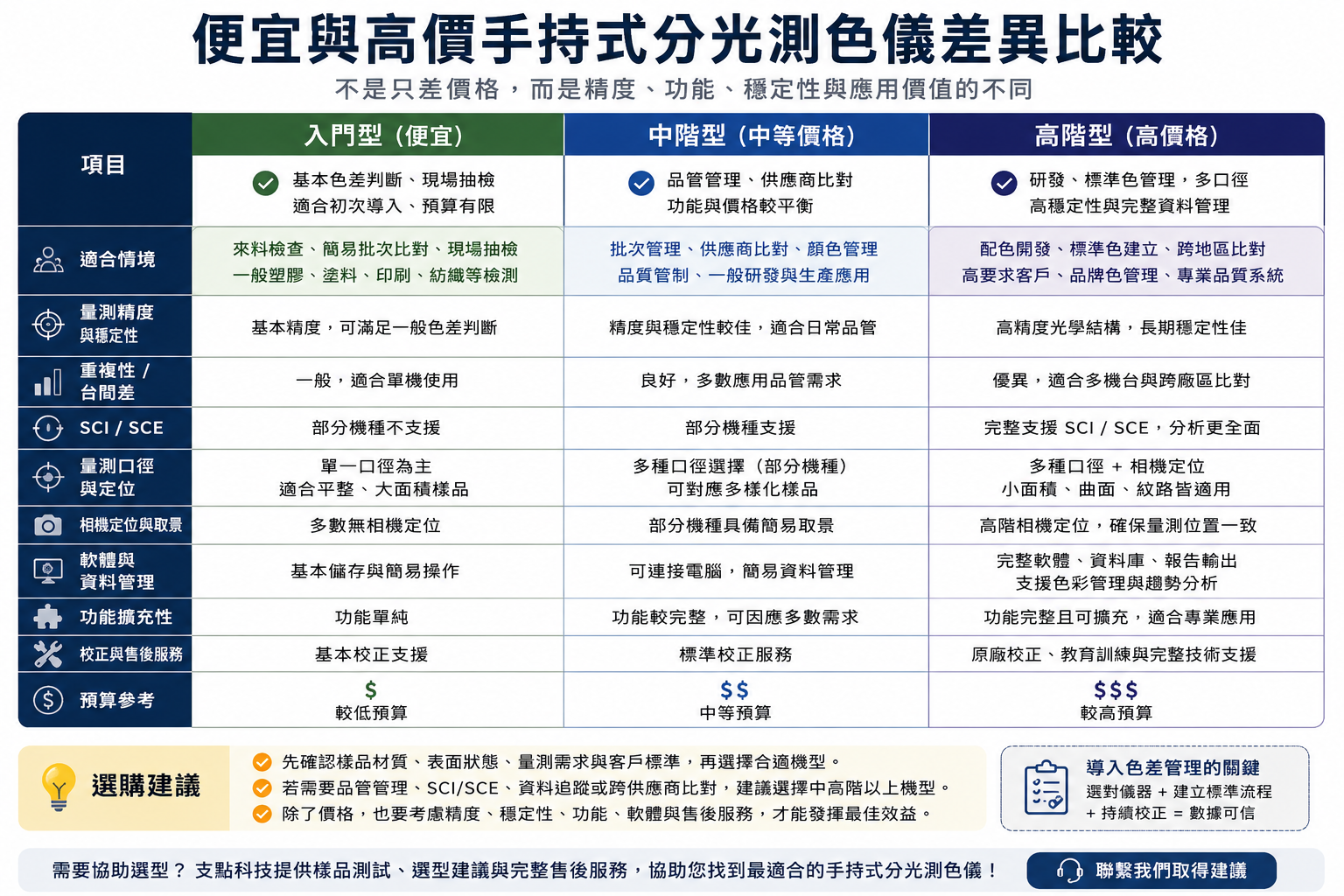
When buying a handheld spectrophotometer, many people ask why some models are affordable while high-end models cost much more. The difference is not simply the brand or appearance. It can involve optical design, sensors, repeatability, instrument-to-instrument agreement, SCI/SCE, measurement apertures, camera positioning, software, calibration support and after-sales service.
For basic incoming inspection, an entry-level instrument may be sufficient. For plastics, coatings, inks, textiles, printing, automotive interiors, brand colors or supply-chain color control, stability and advanced functions can be more important. The key is not only the ΔE from one reading, but also whether repeated readings on the same sample are consistent, whether different instruments agree, and whether suppliers and customers can communicate using the same conditions.
Entry-level handheld spectrophotometers are generally suitable for companies beginning color management, routine spot checks, preliminary incoming-material screening and simple batch comparisons. They are usually easy to use and portable, with basic L*a*b*, ΔE and color-difference functions. If the task is simply to compare a sample with a standard, an entry-level model can be practical. Confirm its repeatability, aperture, software and compliance with customer requirements.
The value of a high-end instrument becomes clearer in long-term quality control involving multiple devices and varied samples. Typical advantages include stronger repeatability and inter-instrument agreement, SCI/SCE modes, multiple apertures, camera preview or positioning, color databases, report output, calibration support and training. These features can benefit R&D and color formulation, standard-color management, cross-site comparisons and demanding customer acceptance.
When comparing models, review five areas: (1) repeatability, instrument-to-instrument difference and long-term stability; (2) whether SCI/SCE helps distinguish material color from surface gloss; (3) whether apertures and positioning suit small samples, curves, textures, fabric or plastic parts; (4) whether software can store standards and batch records, generate reports and track trends; and (5) whether calibration, training and service fit your rollout plan.
Entry-level models usually suit basic color checks and spot inspections. Mid-range models often balance functions and cost for routine quality control and supplier comparisons across plastics, coatings, printing and textiles. High-end models are more suitable for R&D, color departments, standard-color programs, multi-instrument or multi-site comparisons, and demanding customer requirements. No price tier is universally best; the right choice is the one that fits the actual task.
Do not choose on price alone when measurements affect shipment release, customer acceptance, brand standards or decisions across suppliers. If samples have gloss, matte finishes, texture, curves or small measurement areas—or if you need SCI/SCE, spectral data, a color database or reports—consider mid-range or high-end models. Test representative samples before purchase and confirm the customer’s measurement conditions, workflow, total cost of ownership and service coverage.
Frequently asked questions
Q: Can an entry-level handheld spectrophotometer be used? A: Yes, for routine spot checks, simple batch comparisons or an initial color-management program. For customer standards, R&D formulation or high-precision quality control, evaluate mid-range or high-end models.
Q: Does a higher price always mean better accuracy? A: No. Price may reflect functions, stability, aperture options, software and service. Suitability depends on the sample and measurement objective.
Q: What are the main differences between entry-level and high-end models? A: Common differences include repeatability, inter-instrument agreement, SCI/SCE, apertures, camera positioning, data management, reports, calibration and support.
Q: Which industries may need a high-end model? A: Plastic appearance parts, automotive interiors, coatings, inks, print and packaging, textiles, leather, cosmetics, brand-color programs and R&D labs.
Q: When is SCI/SCE useful? A: It can help separate material color from surface-reflection effects on glossy, matte, textured or otherwise varied samples.
Fulcrum Technology can help compare handheld spectrophotometers by sample material, inspection goal, budget, customer standards, SCI/SCE and reporting needs.